
Definition
A force is a push or pull exerted on an object resulting from its interaction with another object. A force can cause an object to accelerate by changing its speed, altering its direction of velocity, or causing both. Force is a vector quantity, possessing both magnitude and direction, and follows the rules of vector addition.
SI Unit
The SI unit of force is the newton . One newton is defined as the amount of net force required to accelerate a mass of one kilogram at a rate of one meter per second squared:
Contact and Field Forces
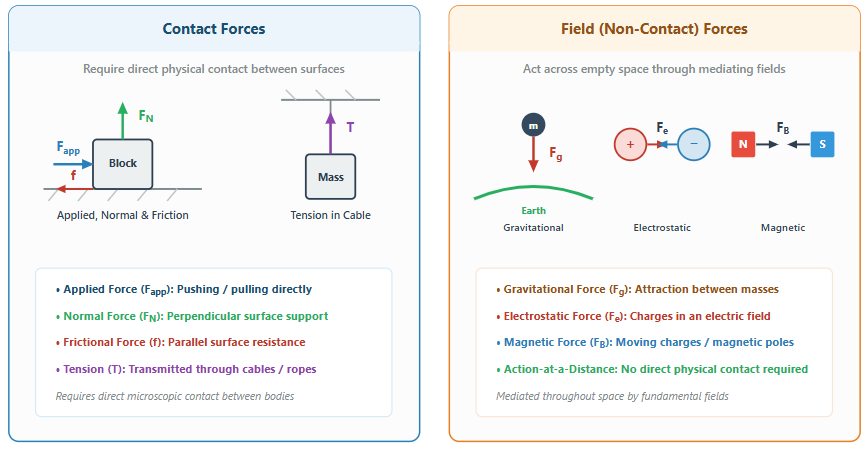
Forces in classical mechanics are categorized into two fundamental classes based on how objects interact:
1. Contact Forces
Contact forces arise from direct physical contact between the interacting surfaces or bodies. Common examples include:
- Normal force exerted perpendicular to a supporting surface
- Tension transmitted through a taut string, cord, or cable
- Frictional force acting parallel to contacting surfaces to oppose sliding motion
- Applied forces exerted by direct pushing, pulling, or muscle action
2. Field Forces
Field forces act across empty space without requiring physical contact between bodies. An object creates a physical field throughout surrounding space that exerts a force on any other responsive body placed within that region. Common examples include:
- Gravitational force between masses (such as Earth pulling downward on an object)
- Electrostatic force between stationary electric charges
- Magnetic force between magnetic poles or moving electric charges
Force as a Vector Quantity
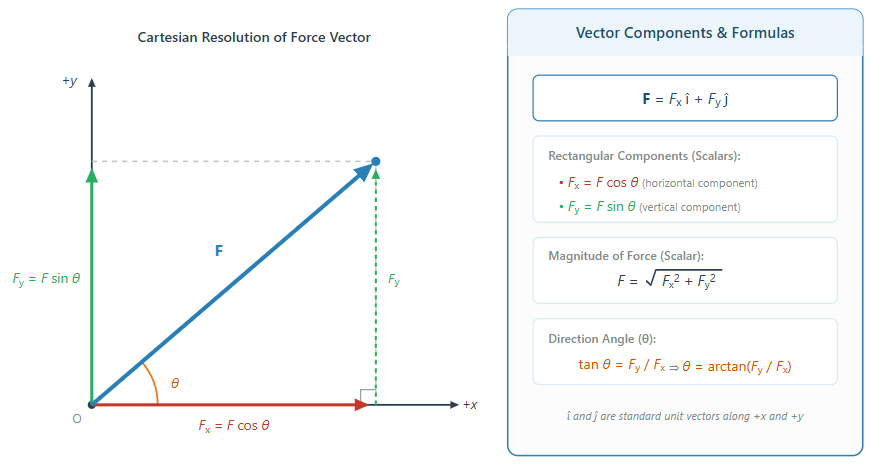
Because force is a vector, a complete description of any force requires specifying its magnitude, direction, and point of application. A force acting in a two-dimensional Cartesian plane can be resolved into perpendicular components:
Where:
- is the component of the force along the x-axis
- is the component of the force along the y-axis
- and are standard unit vectors pointing along the positive x- and y-axes, respectively
The magnitude F of the force is given by:
The angle \theta that the force vector makes relative to the positive x-axis is determined by:
Net Force and the Principle of Superposition
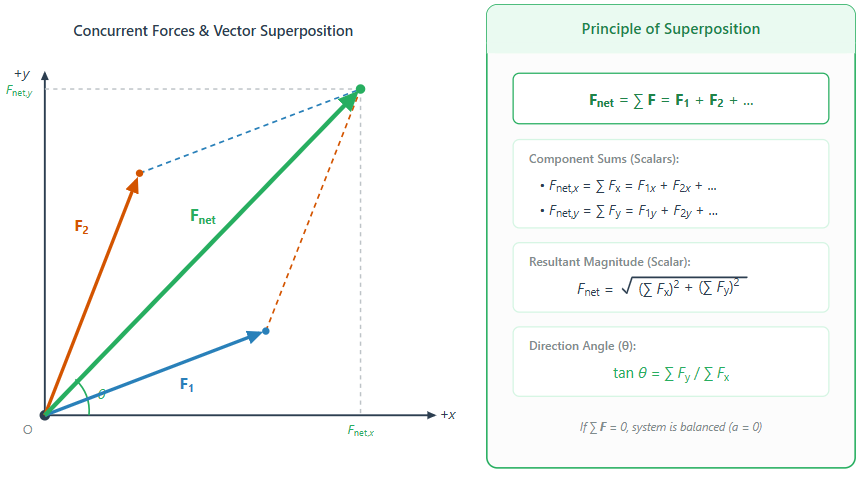
When multiple forces act simultaneously on a single body, their combined physical effect is identical to that of a single equivalent force called the net force (or resultant force) :
The components of the net force along the coordinate axes are calculated by summing the corresponding components of all applied forces:
The overall magnitude of the net force is:
The direction \theta of the resultant force vector relative to the positive x-axis is:
If the vector sum of all forces equals zero , the forces are balanced, and the object maintains a constant state of motion. If , the forces are unbalanced, producing an acceleration in the direction of the net force vector.
Example 1: Net Force Along a Straight Line
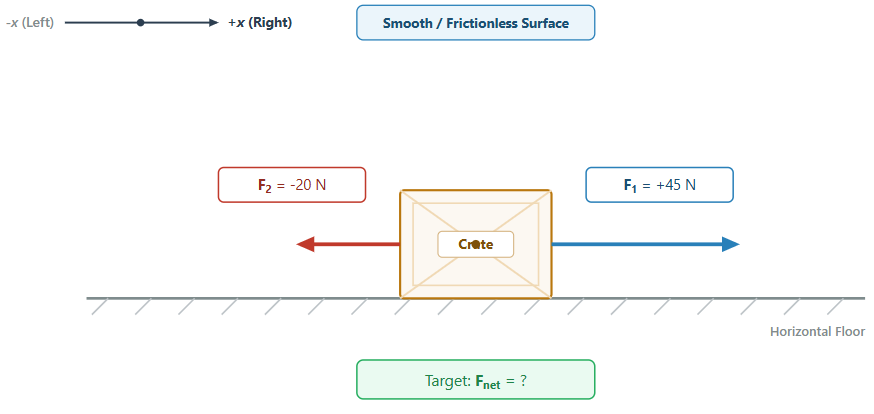
Two horizontal forces act concurrently on a crate resting on a smooth floor. Force has a magnitude of and acts toward the right (+x). Force has a magnitude of and acts toward the left (-x). Find the magnitude and direction of the net force acting on the crate.
Calculation:
Assigning positive to the right (+x) and negative to the left (-x):
Summing the collinear components yields:
The net force acting on the crate has a magnitude of and is directed to the right.
Example 2: Net Force in Two Dimensions
Two ropes pull simultaneously on an eye-bolt anchored to a wall. Rope A exerts a force of magnitude directed at an angle of above the horizontal (+x). Rope B exerts a force of magnitude directed horizontally along the positive x-axis. Determine the magnitude and direction of the resultant force acting on the eye-bolt.
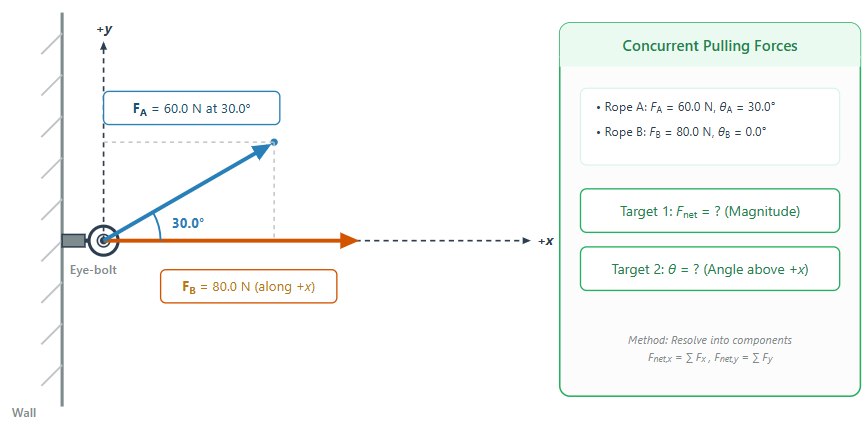
Vector Components:
For Rope A:
For Rope B:
Net Force Components:
Summing along the x-axis:
Summing along the y-axis:
Magnitude of the Resultant Force:
Direction of the Resultant Force:
The net force acting on the eye-bolt has a magnitude of and acts at an angle of above the horizontal.
Key Points
- A force is a vector push or pull resulting from an interaction between two bodies.
- The SI unit of force is the newton , equivalent to .
- Contact forces require physical contact between objects; field forces act over distance through gravitational, electric, or magnetic fields.
- Forces obey the principle of superposition, combining by vector addition into a single net force .
- Balanced forces produce a net force of zero , whereas unbalanced forces cause acceleration.