
Definition
Motion is the change in the position of an object over time relative to a reference point.
An object is in motion if its position changes as time passes. If its position does not change relative to the chosen reference point, the object is at rest.
Whether an object is moving or at rest therefore depends on the reference point used to describe its position.
Motion and Reference Point
Consider a passenger sitting inside a moving train. The passenger remains in the same position relative to the seat, so the passenger is at rest relative to the train.
However, the passenger’s position relative to the ground changes as the train moves. Therefore, the passenger is in motion relative to the ground.
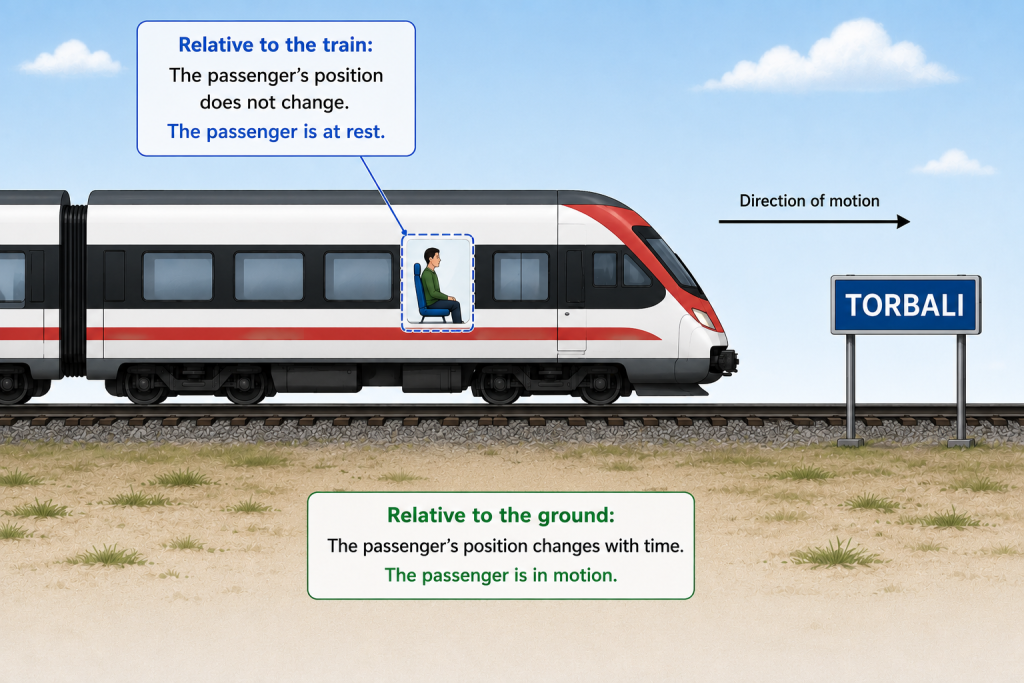
This means that motion is not described independently of a reference point. The same object may be at rest relative to one reference point and in motion relative to another.
Describing Motion
To determine whether an object is in motion:
- Choose a reference point.
- Determine the position of the object relative to that reference point.
- Observe whether the position changes with time.
If the position changes, the object is in motion relative to that reference point.
Key Points
- Motion is a change in position over time.
- Motion must be described relative to a reference point.
- An object may be at rest relative to one reference point and in motion relative to another.
- If an object’s position relative to a reference point changes with time, the object is in motion.