
Definition
Vertical motion describes the movement of an object along a purely vertical path under the influence of gravity.
It encompasses objects projected upward, falling downward, or thrown downward with an initial velocity.
In the absence of air resistance, all vertical motion near Earth’s surface occurs under a constant downward acceleration due to gravity, .
Coordinate System and Sign Conventions
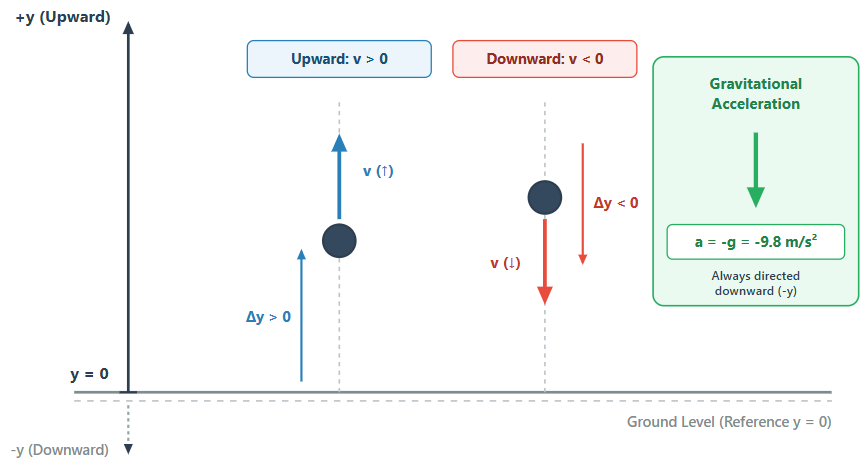
Analyzing vertical motion requires defining a vertical coordinate axis (typically y) and establishing a consistent directional convention.
Adopting the standard convention where upward is positive (+y) and downward is negative (-y):
- Gravitational acceleration always points downward, so throughout the entire motion.
- Upward velocities and upward displacements are positive.
- Downward velocities and downward displacements are negative.
Under this convention, the standard equations of motion become:
Where:
- is the vertical displacement
- is the initial vertical velocity
- is the final vertical velocity
- g is the acceleration due to gravity
- is the time elapsed
Motion of an Object Projected Vertically Upward
When an object is thrown vertically upward with an initial speed :
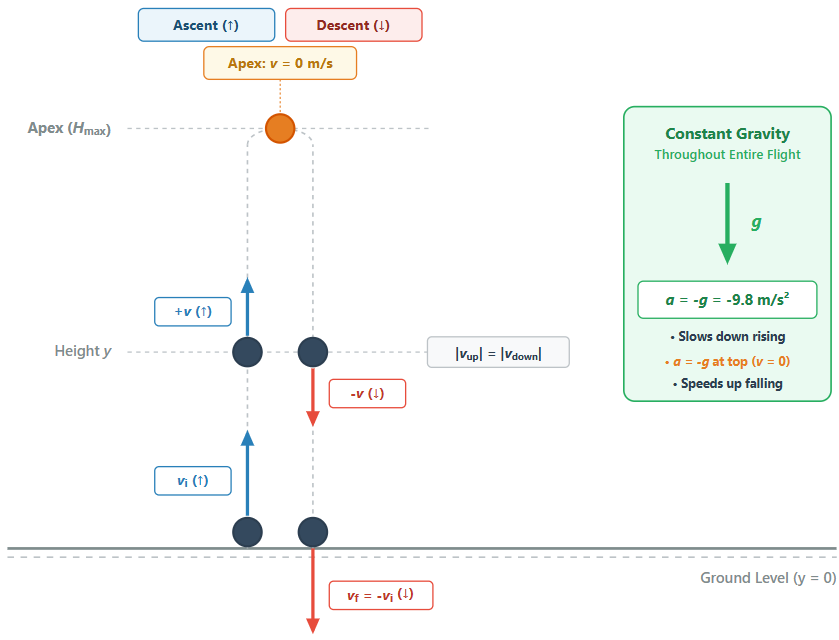
- Upward Flight: As the object rises, its velocity is directed upward (+), but its acceleration is directed downward (-). Because velocity and acceleration have opposite signs, the object slows down steadily at a rate of each second.
- Highest Point (Apex): At maximum height, the object stops rising and is momentarily at rest. Its instantaneous velocity is strictly zero . However, the acceleration remains ; gravity does not cease at the top.
- Downward Flight: As the object falls back down, both its velocity and acceleration point downward (-). Because velocity and acceleration share the same sign, the object speeds up steadily.
Symmetry in Vertical Motion
When an object is thrown upward and returns to its initial launch height (in the absence of air resistance), the trajectory exhibits two fundamental symmetries:
- Time Symmetry: The time required to reach maximum height (time of ascent, ) is exactly equal to the time required to fall back to the launch height (time of descent, ). The total flight time is .
- Velocity Symmetry: At any given height, the speed during the upward journey is equal to the speed during the downward journey, but with opposite signs. The object lands with a final velocity equal in magnitude and opposite in direction to its launch velocity: .
Maximum Height and Time to the Top
Setting at the peak yields concise expressions for maximum height and time to rise:
From :
From :
Example 1: Ball Thrown Vertically Upward
A tennis ball is thrown vertically upward from ground level with an initial velocity of . Find the time taken to reach the maximum height, the maximum height reached, and the total time the ball remains in the air before returning to the ground.
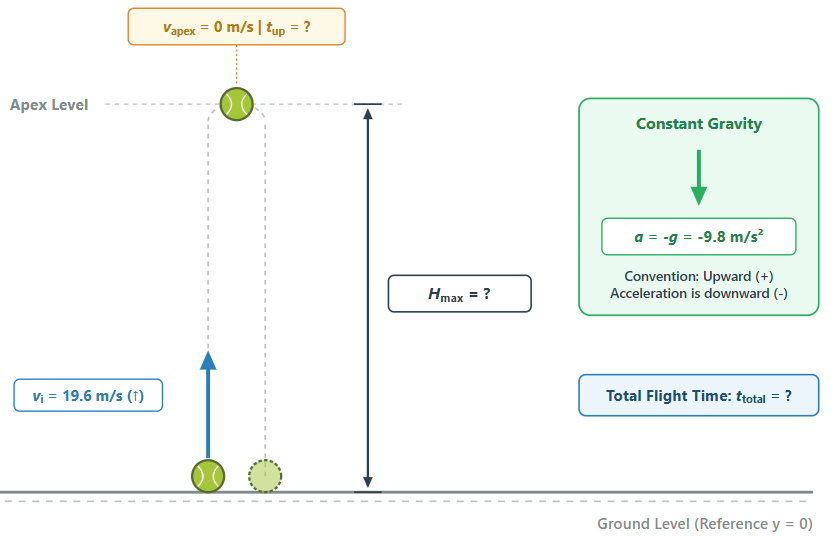
Time to Reach Maximum Height:
At maximum height, :
Maximum Height:
Using the time-independent equation:
Total Time of Flight:
Due to motion symmetry, total flight time is twice the time of ascent:
Example 2: Object Thrown Downward from an Elevated Position
A stone is thrown vertically downward from the edge of a cliff high with an initial velocity of . Find the velocity of the stone just before it strikes the ground.
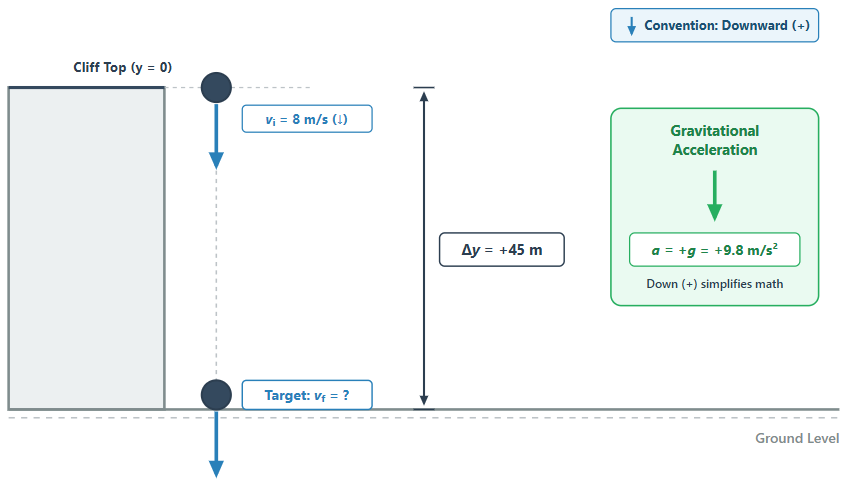
Choosing downward as positive (+y) simplifies the calculation: , , and .
Using the time-independent kinematic equation:
The velocity of the stone just before impact is directed downward.
Key Points
- Vertical motion is straight-line motion under the constant downward acceleration of gravity,.
- A clear sign convention must be defined; under the standard upward-positive convention, acceleration is always .
- At the highest point of upward flight, the instantaneous velocity is momentarily zero , but the acceleration remains downward.
- In symmetrical flight over level ground, time of ascent equals time of descent .
- At identical heights along the flight path, upward and downward speeds are equal in magnitude and opposite in sign.
- For objects thrown downward, initial velocity and acceleration act in the same direction, causing the object to speed up immediately.