
Definition
Projectile motion is the two-dimensional motion of an object launched into the air and moving under the influence of gravity alone. An object executing this motion is called a projectile, and the curved path it follows is called its trajectory. In the absence of air resistance, the path of every projectile near the surface of the Earth is a parabola.
Independence of Horizontal and Vertical Motions
The fundamental principle of projectile motion is that the horizontal motion and the vertical motion are completely independent of each other. Neither motion influences the other; they share only the common variable of elapsed time .
- Horizontal Motion: No horizontal forces act on the projectile. Therefore, the horizontal acceleration is zero , and the horizontal velocity remains constant throughout the entire flight.
- Vertical Motion: The downward gravitational force acts continuously on the projectile. Therefore, the vertical acceleration is constant and directed downward , exactly identical to free-fall or vertical motion.
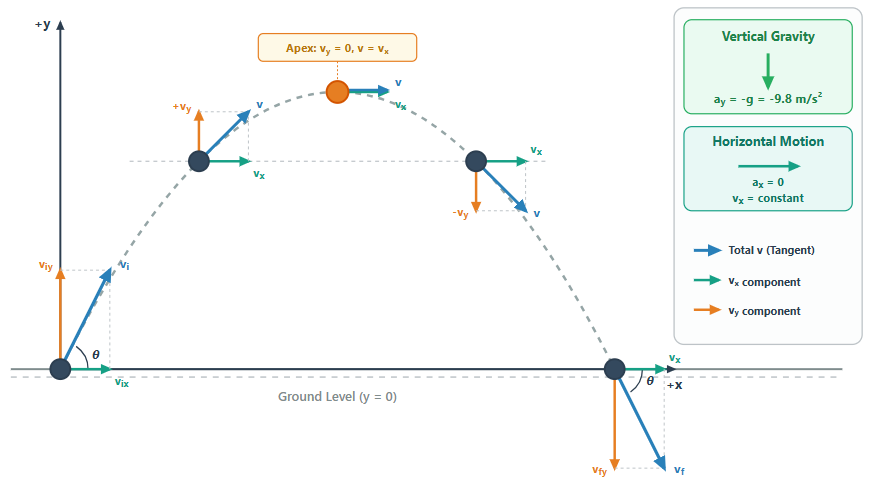
Initial Velocity Components When a projectile is launched with an initial speed at an angle above the horizontal, its initial velocity vector is resolved into rectangular components:
Where:
- is the initial launch speed
- is the launch angle relative to the horizontal ground
- is the horizontal component of initial velocity
- is the vertical component of initial velocity
Kinematic Equations for Projectile Motion
Choosing the standard coordinate system where rightward is positive (+x) and upward is positive (+y):
Horizontal Kinematics (Uniform Motion, ):
Vertical Kinematics (Uniformly Accelerated Motion, ):
Instantaneous Velocity and Speed
At any point during the flight, the total velocity vector is the vector sum of its horizontal and vertical components:
The magnitude of the instantaneous velocity (the speed ) is:
The direction angle of the velocity relative to the horizontal is:
At the highest point (apex) of the trajectory, the vertical velocity is momentarily zero . The velocity of the projectile is not zero at the peak; it is strictly horizontal and equal to its initial horizontal component .
Analysis of Level-Ground Projectile Motion For a projectile launched and landing at the same horizontal level :
Time of Flight:
Setting in the vertical position equation:
Maximum Height :
At maximum height,. Using the vertical kinematic equation:
Horizontal Range (R):
The horizontal distance traveled during the total time of flight is:
Using the trigonometric identity :
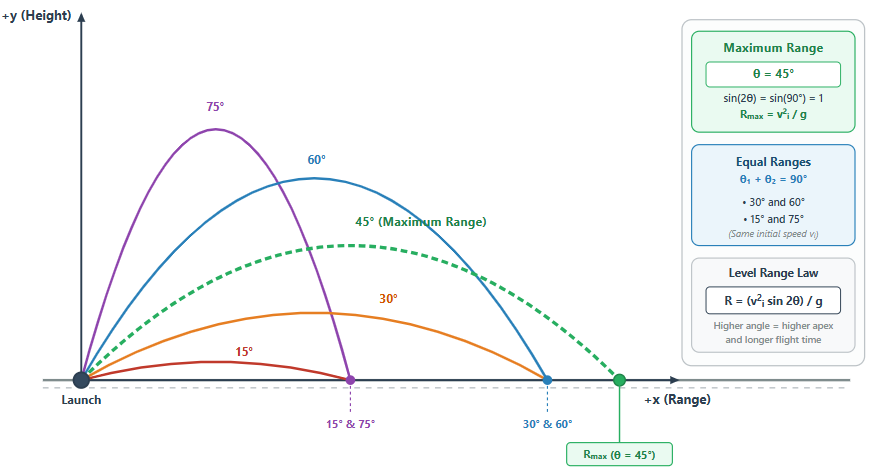
The range reaches its theoretical maximum when , which corresponds to a launch angle of . Complementary launch angles (e.g., and ) produce identical horizontal ranges for the same launch speed.
Example 1: Horizontally Launched Projectile
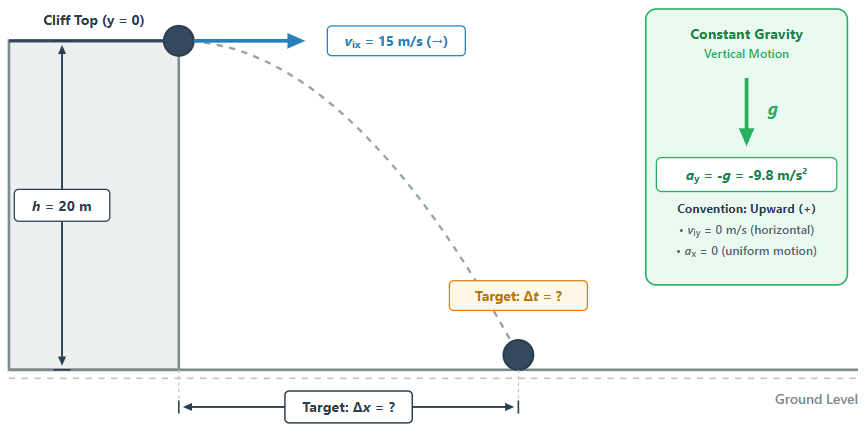
A ball is projected horizontally from the edge of a flat cliff high with an initial speed of .
Find the time taken for the ball to reach the ground and the horizontal distance from the base of the cliff to the landing point.
Vertical Motion and Time of Flight:
Because the launch is strictly horizontal, the initial vertical velocity component is zero . Choosing upward as positive (+y), the vertical displacement is and vertical acceleration is :
The ball is in the air for approximately .
Horizontal Motion and Landing Distance:
No horizontal forces act on the projectile, so horizontal acceleration is zero and horizontal velocity remains constant :
The ball lands approximately from the base of the cliff.
Example 2: Projectile Launched at an Angle
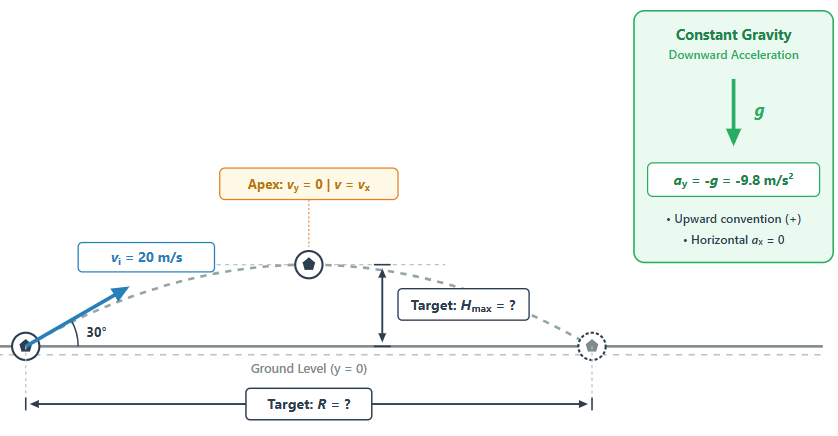
A soccer ball is kicked from the ground with an initial velocity of at an angle of to the horizontal.
Find the maximum height reached by the ball and the total horizontal range.
Velocity Components:
Maximum Height: At the peak, :
Total Horizontal Range:
Key Points
- Projectile motion consists of independent horizontal and vertical motions linked solely by time.
- Horizontal velocity remains constant throughout the motion because horizontal acceleration is zero.
- Vertical acceleration is constant and directed downward due to gravity .
- At the peak of the trajectory, the vertical velocity is zero , but the horizontal velocity is not zero.
- For motion over level ground, maximum range occurs at a launch angle of .
- Complementary launch angles launched at the same initial speed achieve identical horizontal ranges.