
Definition
A frame of reference is a coordinate system combined with a clock used by an observer to measure and record the position, velocity, and acceleration of an object.
Motion is not absolute; any physical description of movement depends entirely on the reference frame chosen by the observer.
An observer fixed within a specific reference frame defines their own origin, spatial coordinate axes, and standard of time.
Motion and Observers
To describe the motion of an object, an observer must specify an origin and coordinate axes.
Consider a passenger seated on a train moving forward at constant velocity:
- Relative to the train frame, the passenger remains stationary at a fixed coordinate.
- Relative to the ground frame, the passenger moves forward with the velocity of the train.
Both descriptions are physically valid within their respective frames. Kinematic quantities such as displacement and velocity are relative and depend directly on the chosen reference frame.
Inertial Frames of Reference
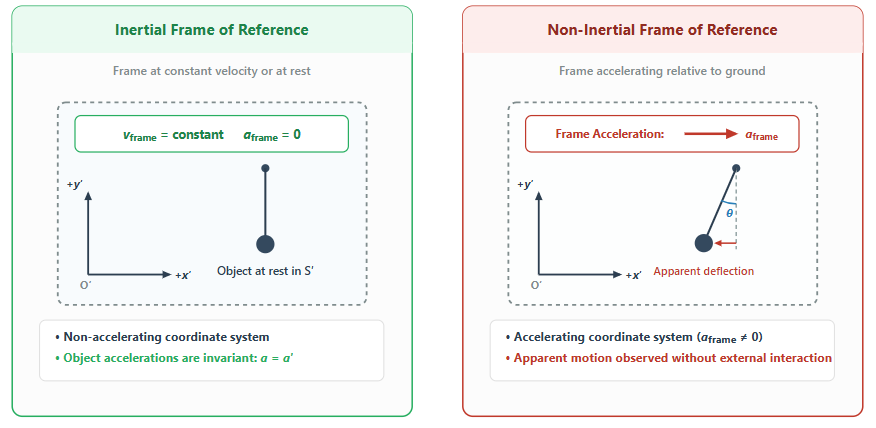
An inertial frame of reference is a non-accelerating frame of reference.
In an inertial frame of reference:
- The frame itself is either stationary or moving at a constant velocity in a straight line.
- The acceleration of the frame is strictly zero .
Any reference frame moving at constant velocity relative to an inertial frame is also an inertial frame. For most kinematic analyses, a reference frame attached to the surface of the Earth is treated as an inertial frame.
Non-Inertial Frames of Reference
A non-inertial frame of reference is a frame of reference that accelerates relative to an inertial frame.
In a non-inertial frame:
- The coordinate system itself has a non-zero acceleration .
- Observers inside an accelerating frame observe apparent accelerations of objects even when no kinematic cause is visible inside the frame.
Examples of non-inertial reference frames include a vehicle speeding up, a braking car, or a platform turning in a curve.
Transformations Between Reference Frames
Consider a stationary reference frame S (the ground) and a reference frame S’ moving with a constant horizontal velocity relative to S.
If an object has position vector at time t in Frame S’, its position vector in Frame S is given by the Galilean position transformation:
Differentiating position with respect to time yields the velocity transformation:
Where:
- is the velocity of the object measured in Frame S
- is the velocity of the object measured in Frame S’
- is the constant velocity of Frame S’ relative to Frame S
Differentiating velocity with respect to time yields the acceleration relation:
Because Frame S’ moves at constant velocity , its acceleration relative to Frame S is zero :
The measured acceleration of an object is identical in all reference frames moving at constant velocity relative to each other.
Example 1: Ball Dropped Inside a Moving Train
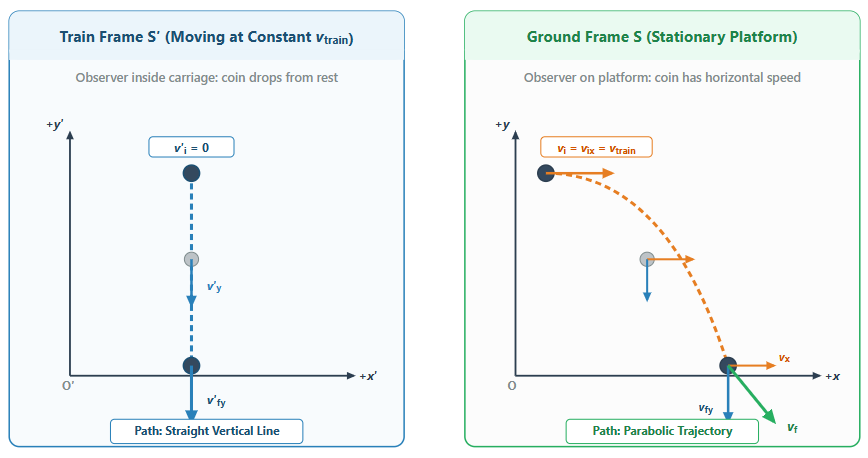
A passenger inside a train moving forward horizontally at a constant speed of drops a coin from rest from a height of above the floor. Find the trajectory shape and the velocity of the coin just before it hits the floor as observed by the passenger on the train and by an observer standing on the ground platform.
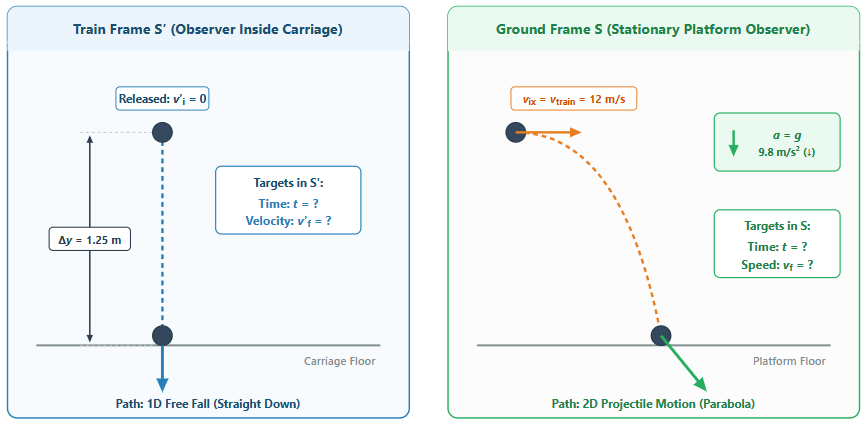
Analysis in the Train Frame (S’): To the passenger, the coin has zero initial velocity and falls straight down under gravity with vertical acceleration :
In the train frame, the coin follows a straight vertical path and hits the floor with a downward velocity of .
Analysis in the Platform Ground Frame (S):
To the observer on the platform, the coin has an initial horizontal velocity equal to the speed of the train while accelerating downward under gravity. The coin executes two-dimensional projectile motion along a parabolic path:
The final speed relative to the platform is:
In the platform frame, the coin follows a parabolic trajectory and strikes the floor with a speed of .
Example 2: Acceleration Measured in Two Reference Frames
A car accelerates along a straight road at relative to the ground. A cyclist travels along the same straight road in the same direction at a constant velocity of relative to the ground. Find the velocity of the car relative to the cyclist after , and find the acceleration of the car as measured by the cyclist.
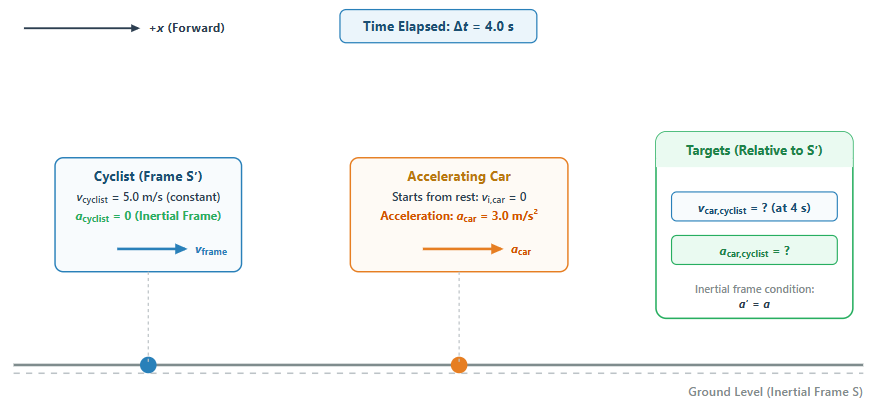
Velocity After 4.0 Seconds: The car starts with initial velocity and accelerates at :
Using the one-dimensional relative velocity relation where both move in the same direction:
After , the car appears to move forward at relative to the cyclist.
Acceleration Measured by the Cyclist: Because the cyclist travels at a constant velocity, the cyclist represents an inertial reference frame:
The cyclist measures the exact same acceleration of for the car as a stationary observer on the ground.
Key Points
- A frame of reference consists of a coordinate system and a time standard used by an observer to measure the position and motion of objects.
- Position, displacement, and velocity depend on the observer’s frame of reference.
- An inertial frame of reference is non-accelerating; it is either at rest or moving with a constant velocity.
- A non-inertial frame of reference is an accelerating frame of reference.
- The acceleration of an object is identical across all inertial reference frames moving at constant relative velocity.
- The perceived shape of a trajectory depends on the reference frame; an object falling vertically in a moving frame traces a parabolic path in a stationary ground frame.