
Definition
Gravitational force is the attractive field force exerted mutually between any two masses across space. Near the surface of an astronomical body such as the Earth, the gravitational pull exerted on an object is defined as its weight.
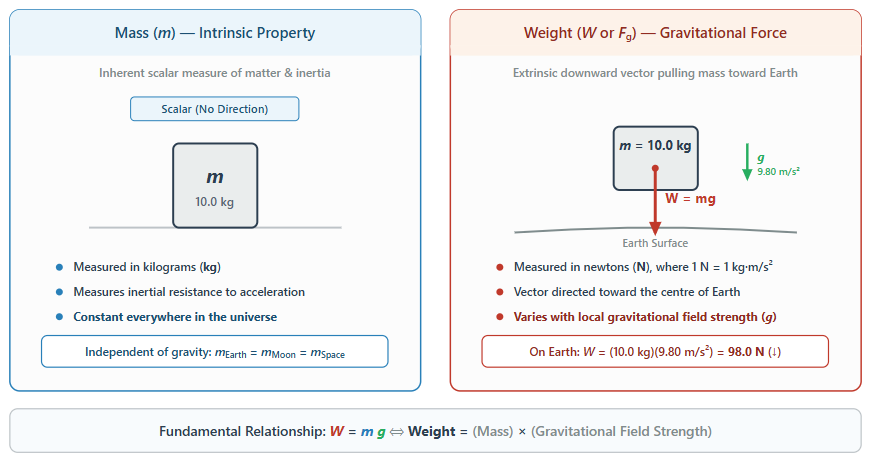
Weight is a vector quantity that is always directed vertically downward toward the centre of mass of the attracting celestial body. Unlike mass, which is an intrinsic, invariant scalar property representing an object’s inertia, weight is an extrinsic environmental force that depends directly on the local gravitational field strength.
SI Unit
The SI unit of weight is the newton .
Because weight is a gravitational force, it shares the standard SI force dimension:
Mathematical Formulation
From Newton’s second law , an object in free fall accelerates solely under gravity with acceleration . The downward gravitational force acting on the object—its weight—is expressed as:
In scalar magnitude:
Where:
- W is the weight of the object, measured in newtons
- m is the mass of the object, measured in kilograms
- g is the local magnitude of gravitational field strength (free-fall acceleration), measured in meters per second squared or newtons per kilogram
Mass versus Weight
Physical mechanics strictly distinguishes between mass and weight:
- Mass (m): A fundamental scalar quantity measuring the quantity of matter and the inertial resistance to acceleration. Mass remains constant regardless of spatial location, altitude, or gravitational environment.
- Weight (W): A derived vector force describing the downward gravitational pull exerted on that mass. Weight varies directly with the local gravitational field strength g.
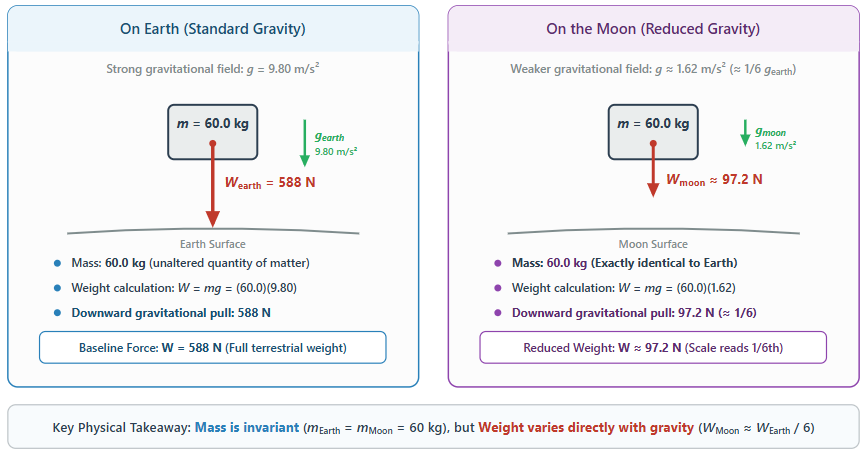
On the surface of the Moon, where , an object has the same mass as on Earth, but its weight is reduced to approximately one-sixth of its terrestrial value.
Apparent Weight and Non-Inertial Reference Frames
Apparent weight is the supporting contact force (typically the normal force from a scale or floor, or tension from a suspension cable) that balances or opposes gravity to support a body.
Consider a person of mass m standing on a weighing scale inside an elevator cab that accelerates along the vertical y-axis. Choosing upward as the positive y-direction:
Solving for the normal force (the scale reading or apparent weight ):
Where:
- is the apparent weight measured by the scale, in newtons
- is the upward normal contact force exerted by the scale floor, in newtons
- is the mass of the person, in kilograms
- is the acceleration due to gravity
- is the vertical acceleration of the elevator, in meters per second squared
Dynamic States of Apparent Weight:
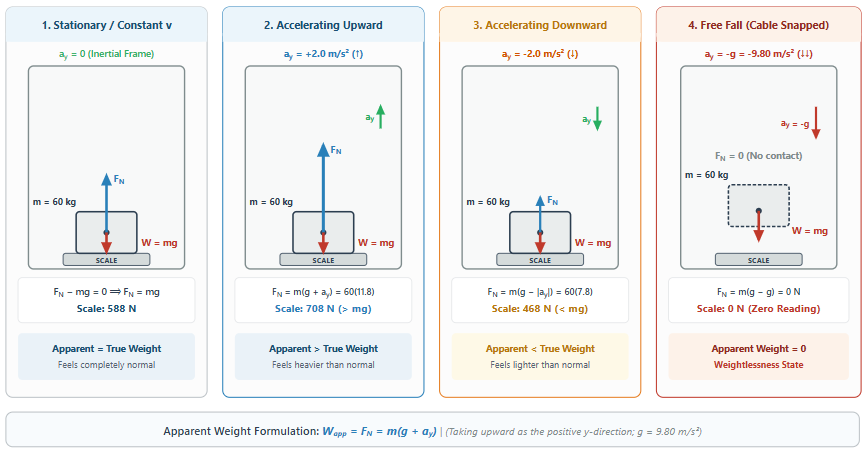
- Stationary or Constant Velocity : The elevator is an inertial frame. . Apparent weight equals true weight.
- Upward Acceleration : The floor pushes upward with extra force to accelerate the mass. . The person feels heavier than normal.
- Downward Acceleration : The floor drops away under the mass. . The person feels lighter than normal.
- Free Fall : If the elevator cable snaps, the cab and person accelerate downward at g. . Apparent weight is zero, producing weightlessness.
Example 1: Calculating Weight on Different Planets
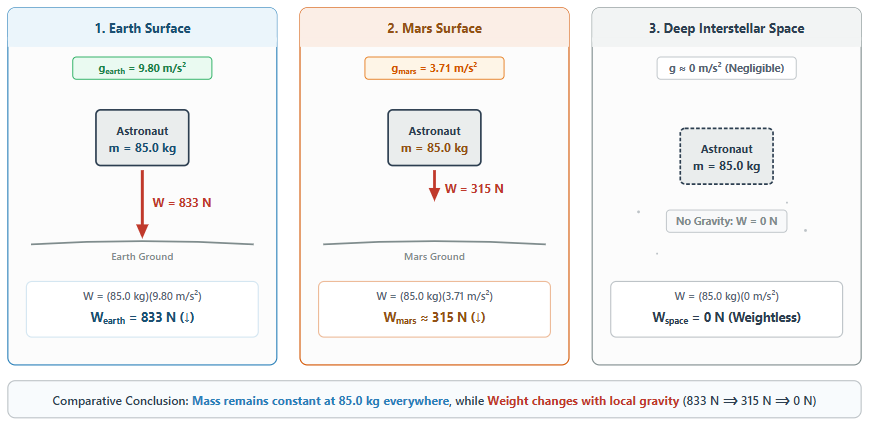
An astronaut equipped with life-support gear has a total mass of . Determine the astronaut’s weight on Earth , on Mars , and in deep interstellar space far from any celestial mass .
Weight on Earth:
Weight on Mars:
Weight in Deep Space:
The astronaut’s mass remains exactly in all three locations, whereas weight varies from , and drops to in deep space.
Example 2: Apparent Weight Inside an Accelerating Elevator
A student of mass stands on a calibrated scale placed inside an elevator. Determine the reading of the scale when the elevator accelerates upward at , and when it accelerates downward at (use ).
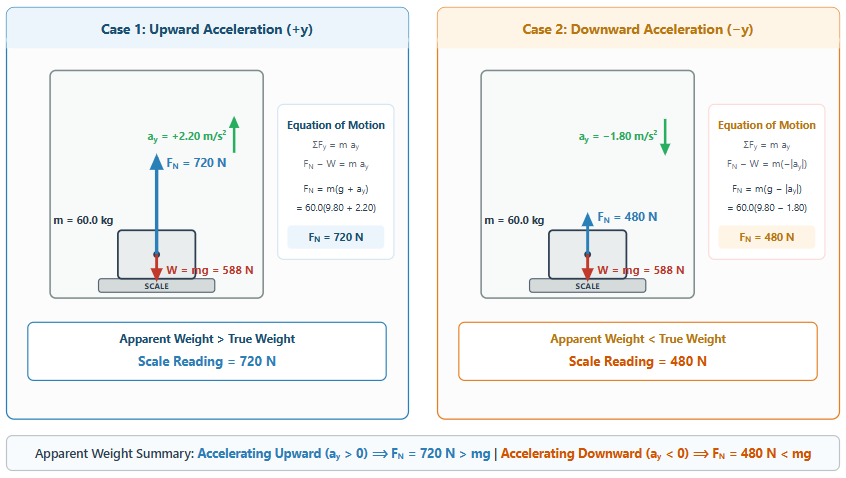
Case 1: Upward Acceleration (+y): Define the positive y-axis upward. The upward acceleration is :
The scale reads an apparent weight of .
Case 2: Downward Acceleration (-y): The downward acceleration means :
The scale reads an apparent weight of .
Key Points
- Gravitational force is an attractive field force pulling masses toward one another across empty space.
- Weight is the downward gravitational force acting on a body near a celestial surface, given by .
- The SI unit of weight is the newton , confirming that weight is a force, not a quantity of matter.
- Mass is an invariant scalar measure of inertia; weight is a variable vector force dependent on the local gravitational field strength g.
- Apparent weight corresponds to the supporting contact force exerted on an object by a scale or floor.
- In vertically accelerating reference frames, apparent weight is calculated by , becoming zero in free fall (weightlessness).