
Definition
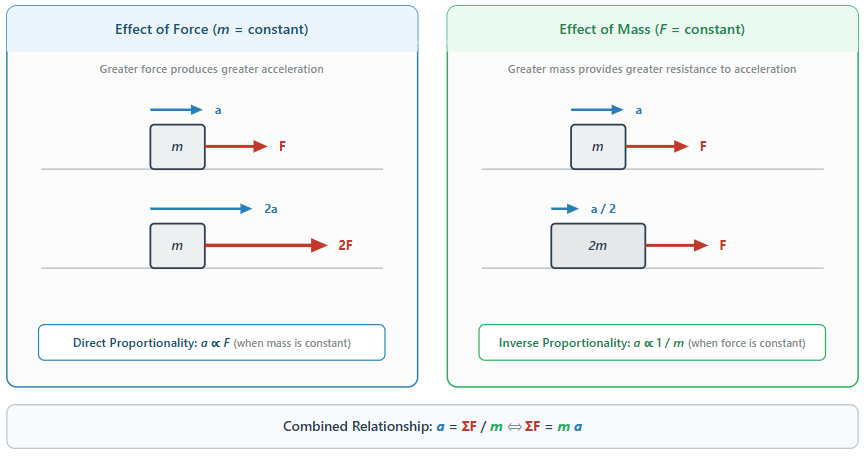
Newton’s second law of motion states that the acceleration of an object is directly proportional to the net external force acting upon it, is inversely proportional to its mass, and occurs in the same direction as the net force. While the first law identifies whether an unbalanced force exists, the second law quantitatively establishes how an unbalanced force changes the state of motion of a body.
Mass represents an object’s quantitative measure of inertia—its resistance to changes in its state of motion. When an unbalanced net force acts on an object, the object undergoes a rate of change of velocity along the direction of that net force.
SI Unit of Force
The SI unit of force is the newton (N).
One newton is defined as the magnitude of net force required to accelerate a mass of one kilogram at a rate of one meter per second squared:
In base SI units, force possesses fundamental dimensions of mass times length divided by time squared
Mathematical Formulation
Newton’s second law is formulated as a fundamental vector equation:
Where:
- is the vector sum of all external forces (net force) acting on the body, measured in newtons
- m is the inertial mass of the body, measured in kilograms
- is the resulting acceleration vector of the body, measured in meters per second squared
Solving explicitly for acceleration highlights cause and effect:
Where:
- is the acceleration vector
- is the net external force vector
- m is the mass of the object
This equation demonstrates two physical dependencies:
- For a constant mass, doubling the net force doubles the resulting acceleration.
- For a constant net force, doubling the mass halves the resulting acceleration.
Component Form in Two Dimensions
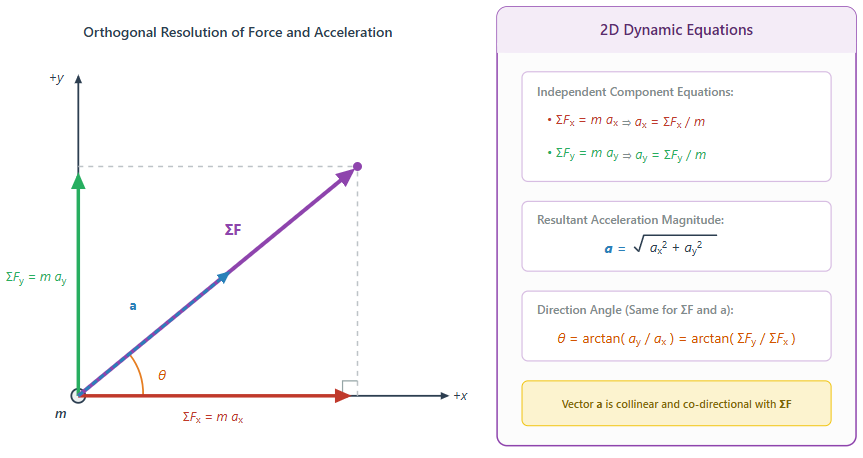
Because force and acceleration are vector quantities, Newton’s second law applies independently along perpendicular coordinate axes:
Where:
- is the algebraic sum of all force components along the horizontal axis, measured in newtons
- is the acceleration along the horizontal axis, measured in meters per second squared
- is the algebraic sum of all force components along the vertical axis, measured in newtons
- is the acceleration along the vertical axis, measured in meters per second squared
The magnitude and direction of the total acceleration vector are determined from its components:
Where:
- is the magnitude of the acceleration vector
- is the horizontal acceleration component
- is the vertical acceleration component
- is the angle of the acceleration vector relative to the positive x-axis
Example 1: One-Dimensional Horizontal Acceleration
A worker pulls a toolbox of mass along a frictionless horizontal floor by applying a constant horizontal force to the right. Simultaneously, a second worker applies a horizontal opposing force to the left. Determine the net horizontal force and the acceleration of the toolbox.
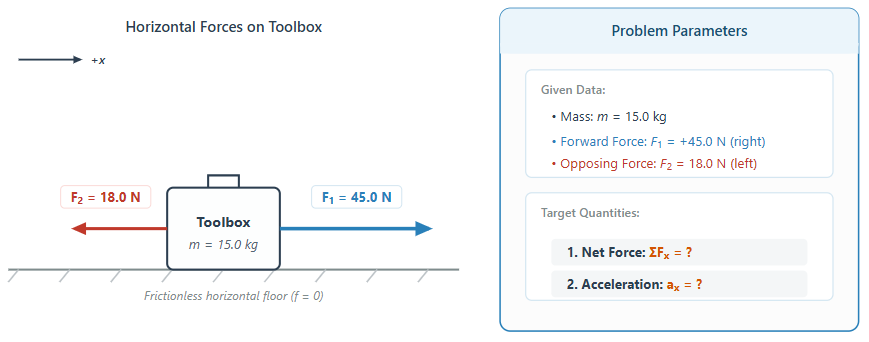
Net Horizontal Force: Define the positive x-direction to the right. The algebraic sum of forces along the x-axis is:
The net force acting on the toolbox is directed to the right.
Horizontal Acceleration: Applying Newton’s second law along the horizontal axis:
The toolbox accelerates to the right at .
Example 2: Angled Applied Force in Two Dimensions
A sled of mass rests on a smooth, frictionless horizontal sheet of ice. A child pulls the sled by a rope with an applied force directed at an angle above the horizontal. Find the horizontal acceleration of the sled and the normal force exerted by the ice on the sled (using ).
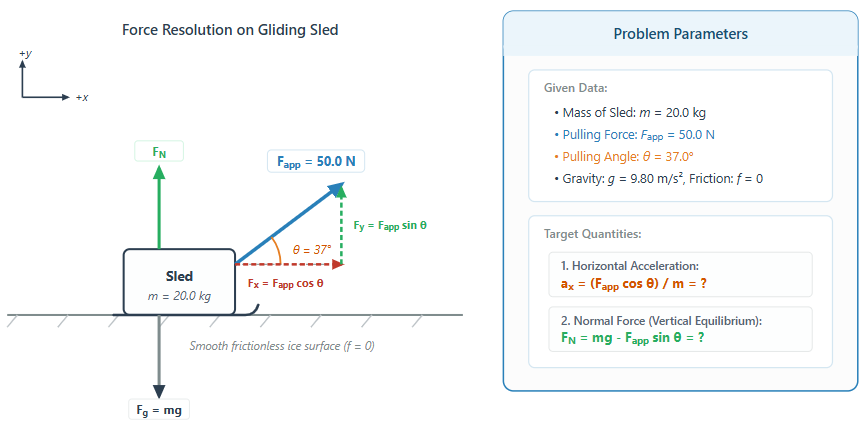
Horizontal Acceleration: Resolve the applied force into its horizontal component:
Because there are no other horizontal forces, .
Applying Newton’s second law along the x-axis gives:
The horizontal acceleration of the sled is directed forward.
Vertical Equilibrium Analysis: Because the sled does not lift off the surface or penetrate the ice, vertical acceleration is zero . The forces acting vertically are the upward normal support force , the upward vertical component of the rope tension , and the downward gravitational force :
Applying equilibrium along the y-axis:
The ice exerts an upward normal support force of on the sled.
Key Points
- Newton’s second law establishes the quantitative relationship between net force, inertial mass, and acceleration .
- Acceleration is directly proportional to the magnitude of the net external force and inversely proportional to the mass of the object.
- The acceleration vector always points in the exact same direction as the net force vector.
- The SI unit of force is the newton , where .
- In two dimensions, Newton’s second law applies independently along the horizontal and vertical coordinate axes and .
- If the net external force acting on a body is zero, acceleration is zero, restoring the condition of Newton’s first law.