
Definition
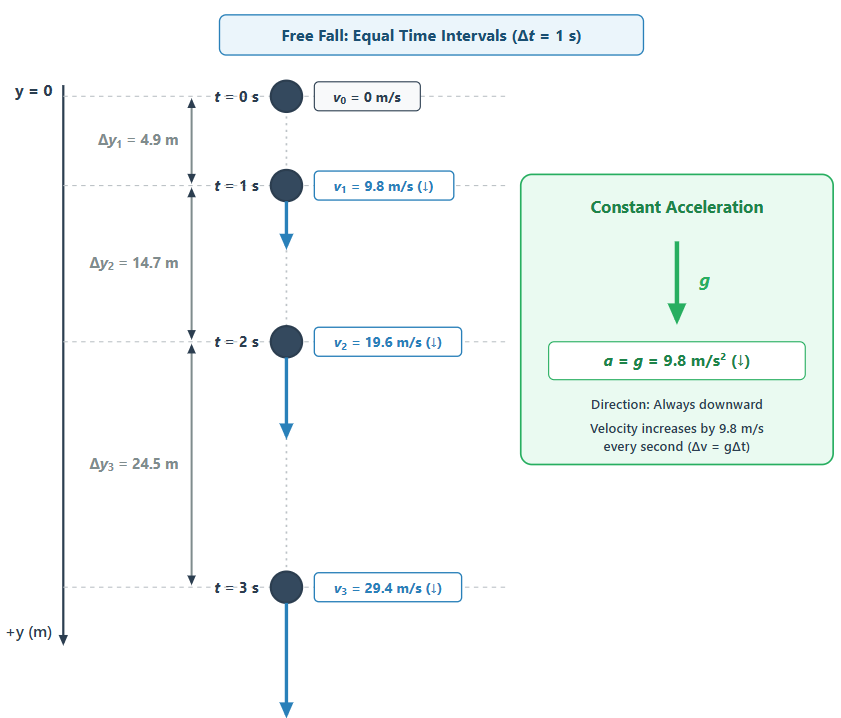
Free fall is the motion of an object moving solely under the influence of gravity. In ideal free fall, air resistance is neglected, and the only force acting on the object is its weight. All objects in free fall near the surface of the Earth experience the same constant downward acceleration, regardless of their mass, size, or shape.
Acceleration Due to Gravity
The acceleration of a freely falling body is called the acceleration due to gravity and is represented by the symbol g.
Near Earth’s surface, the magnitude of g is approximately:
Key characteristics of acceleration due to gravity:
- Direction: Always directed vertically downward toward the center of the Earth.
- Constancy: It remains constant throughout the entire motion, regardless of whether the object is moving upward, momentarily at rest, or moving downward.
- Independence of Mass: In the absence of air resistance, a heavy object and a light object fall with the exact same acceleration.
Sign Conventions and Kinematic Equations
Because free fall is straight-line motion with constant acceleration, the standard equations of motion apply directly. The vertical axis is typically denoted by y, and displacement is written as .
A consistent coordinate system must be established before solving any problem:
- If upward is chosen as positive (+): The acceleration vector points downward, so .
- If downward is chosen as positive (+): The acceleration vector points downward, so .
Adopting the standard convention where upward is positive (+y) and downward is negative (-y), the kinematic equations become:
Where:
- is the vertical displacement
- is the initial velocity
- is the final velocity
- g is the acceleration due to gravity
- is the time elapsed
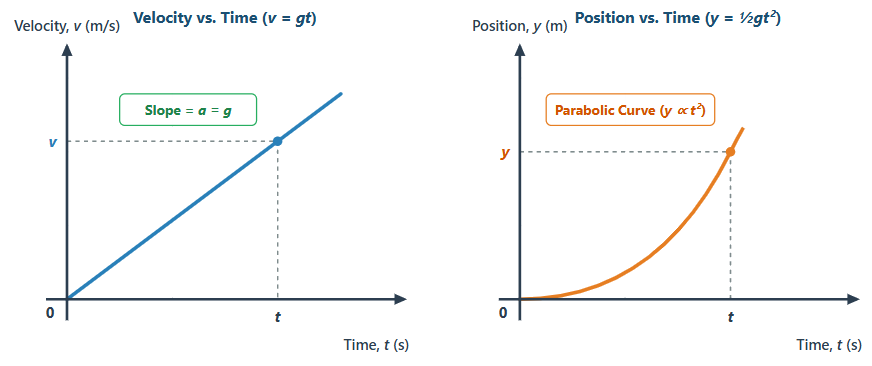
Objects Dropped from Rest When an object is simply released or dropped from rest, its initial velocity is zero . Choosing the downward direction as positive (+y) simplifies the equations of motion for an object dropped from rest:
Example 1: Stone Dropped from a Cliff
A stone is dropped from rest from the top of a tall cliff and falls freely under gravity for . Find the height of the cliff and the velocity of the stone just before striking the ground.
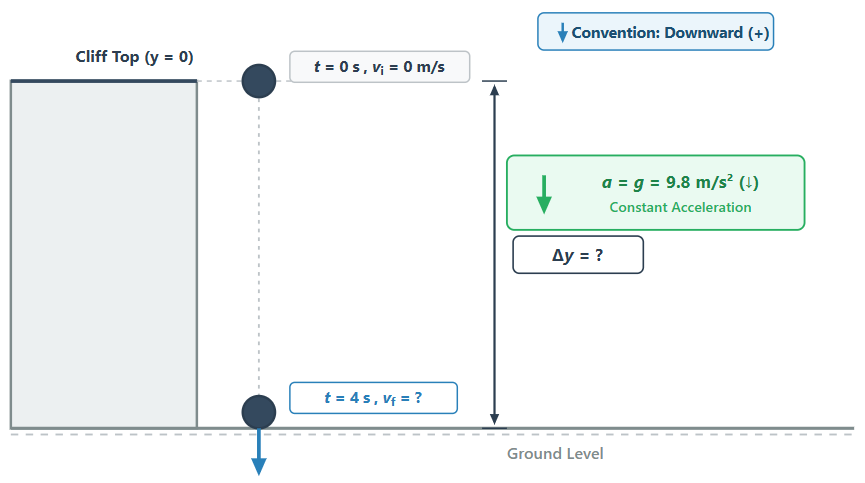
Displacement (Height): Taking the downward direction as positive, and :
The height of the cliff is .
Final Velocity: Using the first kinematic equation:
The velocity of the stone just before striking the ground is directed downward.
Example 2: Reaction Time Drop
A student catches a falling ruler to measure human reaction time. The ruler is released from rest and falls a vertical distance of before being caught. Calculate the reaction time of the student.
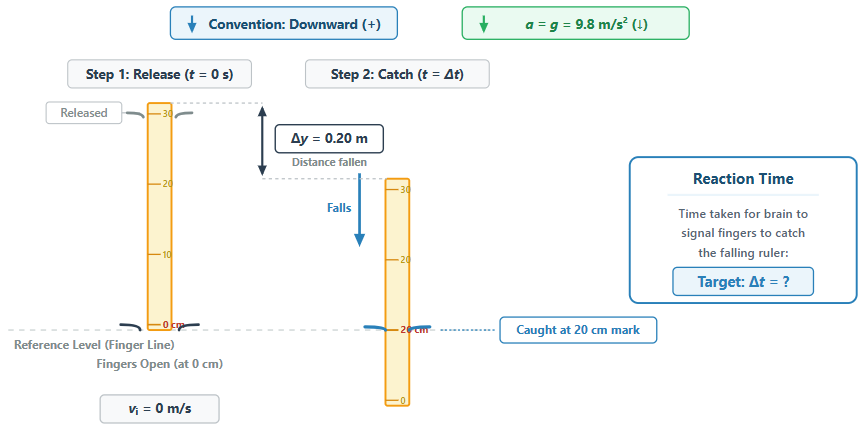
Taking downward as positive, with , , and :
The measured reaction time is approximately .
Key Points
- Free fall refers to the motion of an object solely under the influence of gravity, with air resistance neglected.
- All objects near Earth’s surface experience the same gravitational acceleration, directed downward.
- The acceleration due to gravity is independent of an object’s mass, shape, and density.
- Gravitational acceleration remains constant in magnitude and downward in direction throughout the entire flight.
- An object dropped from rest has an initial velocity of zero .
- A consistent sign convention for the vertical coordinate axis must be established before solving kinematic equations.