
Definition
Newton’s first law of motion states that an object at rest remains at rest, and an object in motion continues in motion with a constant velocity along a straight line, unless acted upon by a net external force. This principle establishes that natural motion requires no continuous cause or driving force; force is required only to alter an object’s state of motion, not to sustain it.
The Concept of Inertia
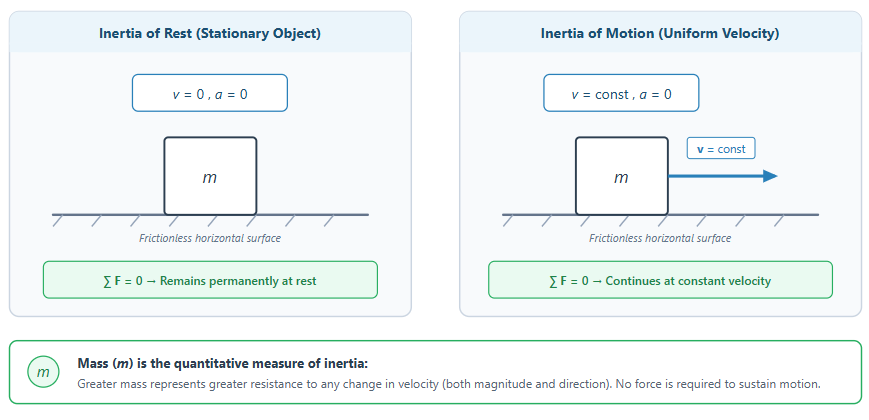
Inertia is the inherent tendency of an object to resist any change in its state of rest or uniform motion. Because of inertia:
- A stationary body naturally remains stationary until an unbalanced force disturbs it.
- A moving body naturally preserves both its speed and its direction unless an unbalanced force intervenes. Mass is the quantitative measure of inertia. An object with greater mass possesses greater inertia and offers greater resistance to any change in its velocity.
Mathematical Condition for the First Law
Newton’s first law corresponds mathematically to the condition where the vector sum of all external forces acting on a body equals zero:
When this condition is satisfied, the net acceleration of the object is strictly zero:
This vector relationship applies independently along each coordinate axis:
Where:
- is the net external force vector acting on the object
- is the algebraic sum of force components along the horizontal axis
- is the algebraic sum of force components along the vertical axis
- is the resulting acceleration vector of the object
Static and Dynamic Equilibrium
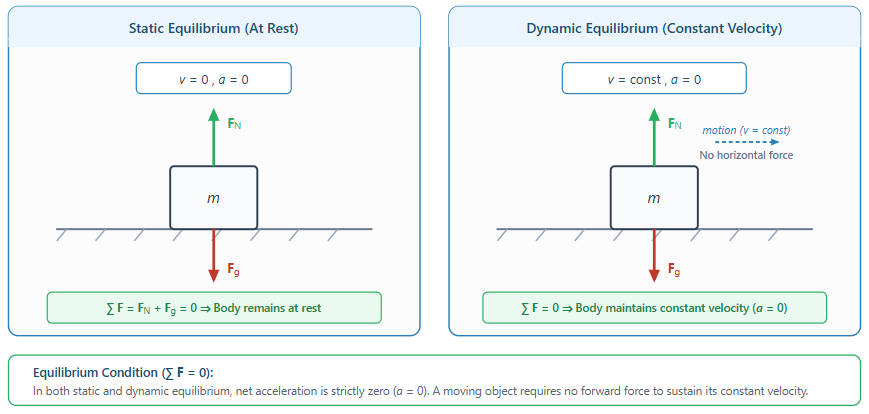
When the net force acting on an object is zero , the object is in mechanical translational equilibrium. Equilibrium occurs in two distinct kinematic states:
1. Static Equilibrium
An object remains permanently at rest relative to an observer:
and
Examples include a book resting undisturbed on a flat tabletop or a framed picture hanging motionless on a wall.
2. Dynamic Equilibrium
An object moves at a constant velocity along a straight path:
and
Examples include a hockey puck gliding across frictionless ice or an aircraft cruising at constant altitude and steady speed.
Newton’s First Law and Inertial Reference Frames
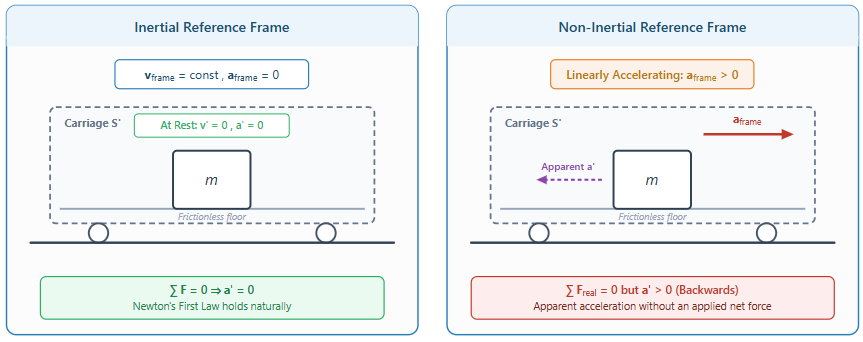
Newton’s first law cannot hold in every frame of reference; it serves as the defining criterion for an inertial frame of reference.
- An inertial frame is a reference frame in which Newton’s first law is strictly observed without introducing fictitious forces.
- Any frame moving at constant velocity relative to an established inertial frame is also an inertial frame.
- In an accelerating (non-inertial) reference frame—such as a turning bus or a braking train—objects appear to accelerate without any applied physical interaction.
Example 1: Gliding Sled on Horizontal Ice
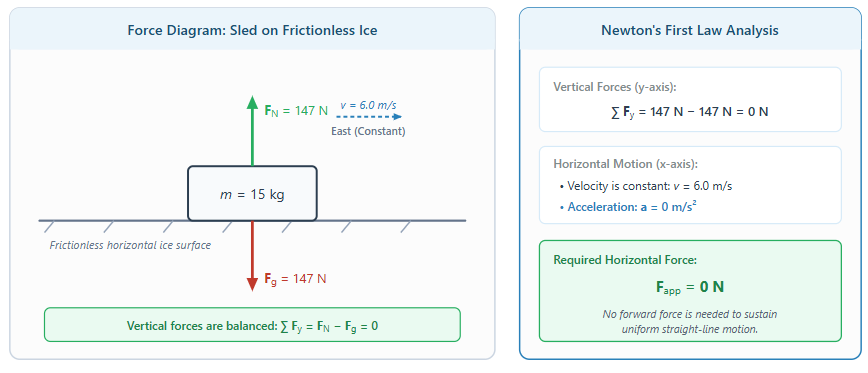
A sled of mass glides across a frozen horizontal lake at a constant velocity of directed toward the east. The downward force of gravity on the sled is , and the upward normal force exerted by the ice is . Assuming friction and air resistance are negligible, find the horizontal force required to maintain this motion and determine the acceleration of the sled.
Horizontal Applied Force:
According to Newton’s first law, an object moving at constant velocity maintains its motion naturally without the need for an applied force:
Because friction is zero, the required forward horizontal force to keep the sled moving at constant velocity is exactly .
Acceleration:
Because the velocity is constant in both magnitude and direction:
The sled remains in dynamic equilibrium under balanced forces.
Example 2: Determining an Unknown Balanced Force
A crate is pulled across a warehouse floor by two horizontal ropes while moving at a constant velocity of along the positive x-axis. The first rope pulls forward with a force of magnitude . A frictional force of magnitude opposes the motion. Determine the magnitude and direction of the force exerted by the second rope.
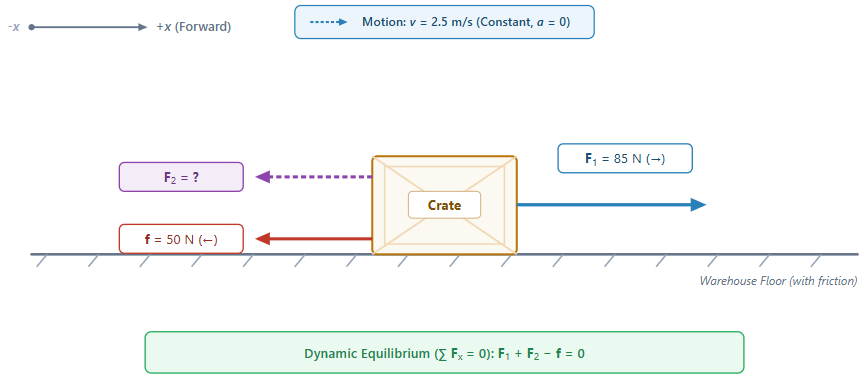
Equilibrium Analysis:
Because the crate travels at constant velocity, its acceleration is zero , and the net horizontal force must equal zero:
Solving for the Unknown Force:
The negative sign indicates that the second force acts in the negative x-direction (opposing the forward pull). The second rope exerts a backward force of .
Key Points
- Newton’s first law states that an object maintains its state of rest or constant straight-line velocity unless acted upon by a net external force.
- Inertia is the tendency of matter to resist changes in its state of motion; mass is the quantitative measure of inertia.
- When the net external force is zero , acceleration is zero .
- Static equilibrium describes a stationary object , whereas dynamic equilibrium describes motion at constant velocity .
- A continuous applied force is not necessary to maintain motion; force is required only to change velocity.
- Newton’s first law holds valid exclusively within inertial frames of reference.