
Definition
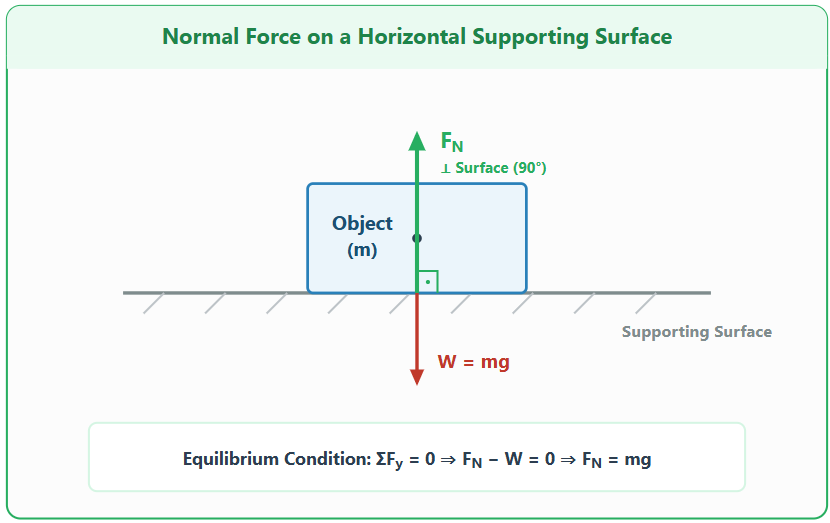
The normal force is the perpendicular contact force exerted by a surface on an object pressing against it. The term “normal” originates from geometry, where it denotes perpendicularity to a plane or tangent line.
The normal force is an electromagnetic contact force arising from microscopic interactions. When an object is pressed against a solid surface, the electron clouds of the atoms in both contact surfaces undergo slight microscopic compression. In response to this interatomic compression, the surface exerts an outward repulsive force perpendicular to the contact interface, preventing the object from penetrating the surface.
SI Unit
The SI unit of normal force is the . Because the normal force is a mechanical contact force, it shares the standard SI unit of force:
Properties of the Normal Force
The normal force exhibits distinct physical characteristics:
- Perpendicular Direction: It is always directed perpendicular (normal) to the contact surface, pointing outward away from the surface into the object.
- Self-Adjusting Nature: The normal force is a passive constraint force. It does not have a single fixed formula; instead, it automatically adjusts its magnitude to whatever value is required to prevent penetration, up to the mechanical breaking limit of the surface.
- Contact Dependence: The normal force exists only while physical contact is maintained. If the object loses contact with the surface, the normal force drops immediately to zero .
- Action-Reaction Pairing: The force exerted by the surface on the object and the force exerted by the object on the surface form a Newton’s third law action-reaction pair. The upward normal force on an object and its downward weight do not form an action-reaction pair because both forces act on the same body.
Determining the Normal Force on Horizontal and Vertical Surfaces
Because the normal force is a constraint force, its magnitude is always determined dynamically by applying Newton’s second law along the axis perpendicular to the contact interface. When there is no acceleration perpendicular to the surface , the forces along that axis must be in translational equilibrium .
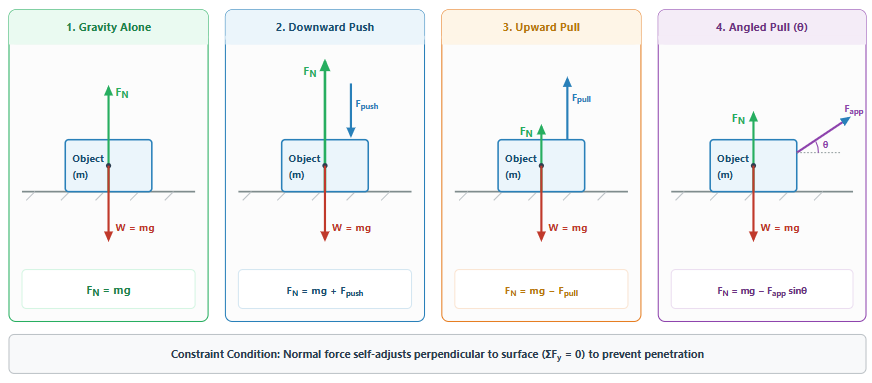
1. Horizontal Surface: Object Subject Only to Gravity
For an object of mass m resting undisturbed on a flat horizontal floor, defining the upward vertical direction as positive (+y):
Where:
- is the magnitude of the normal force, measured in newtons
- W is the downward gravitational force (weight), measured in newtons
- m is the mass of the object, measured in kilograms
- g is the acceleration due to gravity
2. Horizontal Surface: Additional Downward Vertical Force
When an external downward force presses directly on top of the object, the surface must support both the object’s weight and the applied push:
Where:
- is the upward normal force exerted by the floor
- is the external downward pressing force
3. Horizontal Surface: Upward Vertical Pull (Partial Support)
When an external upward force pulls vertically on the object without lifting it entirely off the floor (where ):
Where:
- is the external upward lifting force If the upward pulling force equals the weight , contact is on the verge of breaking and . If , the object accelerates upward off the surface, and no normal force acts on it.
4. Horizontal Surface: Applied Force at an Angle
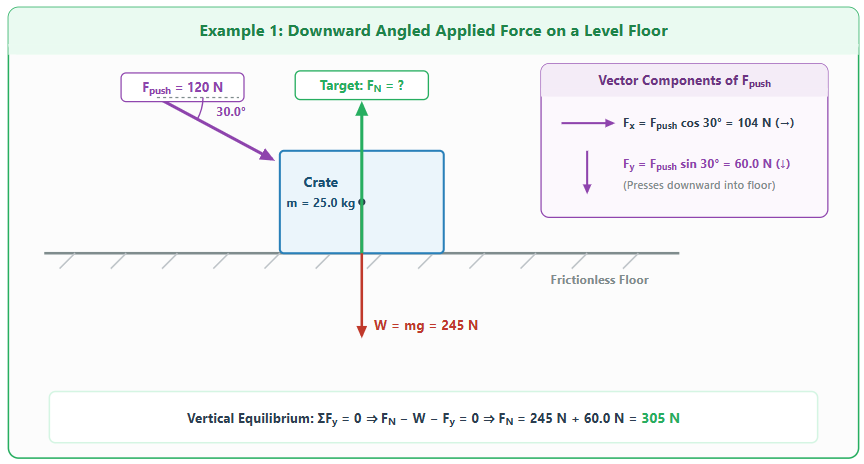
When an external force acts at an angle relative to the horizontal, its vertical component modifies the normal force:
Case A: Angled push directed downward at angle below the horizontal:
Case B: Angled pull directed upward at angle above the horizontal:
Where:
- is the magnitude of the applied angled force
- is the angle of the applied force relative to the horizontal plane
5. Vertical Surface: Object Pressed Against a Wall
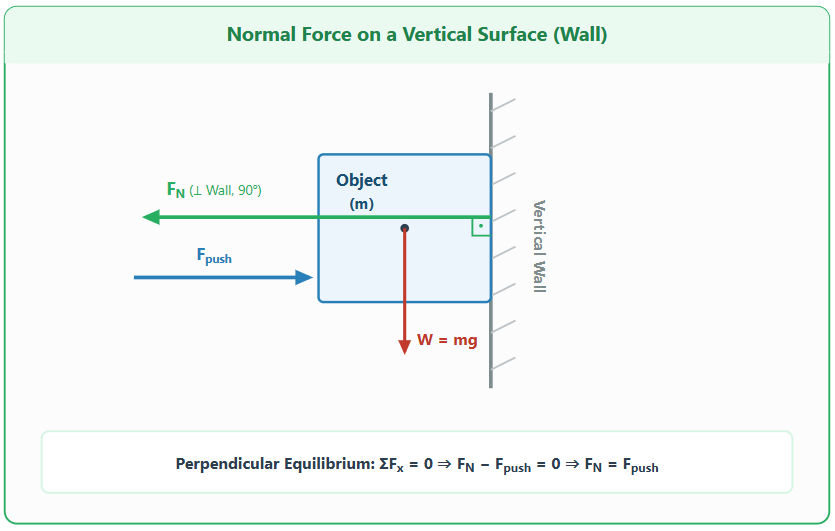
When an object of mass m is pressed horizontally against a rigid vertical wall by a horizontal force , the normal force is entirely horizontal:
- The contact surface is vertical (in the y-z plane).
- Therefore, the normal force acts horizontally perpendicular to the wall (along the x-axis).
Establishing the horizontal x-axis perpendicular to the wall:
Where:
- is the horizontal normal force exerted outward by the wall
- is the horizontal force pressing the object against the wall
Notice that the gravitational force acts vertically downward along the wall and does not enter the perpendicular equilibrium equation for . The normal force depends solely on how hard the object is pressed horizontally against the wall.
Example 1: Vertical Pushes and Pulls on a Floor
A block of mass rests on a flat horizontal floor. Assume .
(a) Find the normal force exerted by the floor on the block when no external forces act.
(b) Find the normal force if a person pushes straight down on the block with a vertical force of .
(c) Find the normal force if a cord pulls straight upward on the block with a tension force of .
Weight of the Block:
(a) Resting State:
(b) Downward Push of 30.0 N:
The floor exerts an upward normal force of .
(c) Upward Pull of 50.0 N:
The floor exerts an upward normal force of .
Example 2: Holding a Book Against a Vertical Wall
A student presses a textbook of mass against a vertical wall by applying a horizontal force of perpendicular to the wall.
(a) Determine the magnitude and direction of the normal force exerted by the wall on the textbook.
(b) If the student increases the horizontal pressing force to , what is the new normal force exerted by the wall?
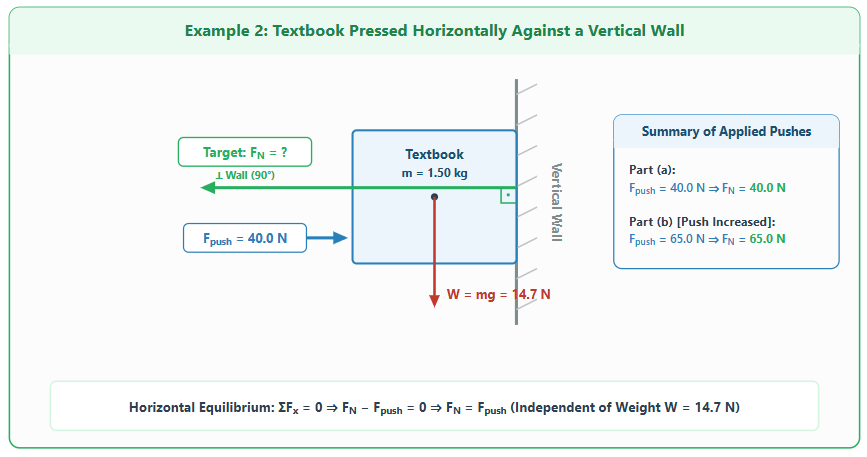
(a) Initial Normal Force: Define the horizontal axis perpendicular to the wall, with the outward direction from the wall as positive (+x). Because the book does not move into or out of the wall, horizontal acceleration is zero :
The wall exerts a normal force of directed horizontally outward, perpendicular to the wall surface.
(b) Increased Pressing Force: The normal force self-adjusts to match the new perpendicular contact force:
The new normal force is directed horizontally outward. The weight of the book acts downward parallel to the wall and does not alter the normal force magnitude.
Key Points
- The normal force is a perpendicular contact force exerted by a solid surface to oppose penetration.
- The normal force is an electromagnetic contact force generated by microscopic interatomic repulsion.
- Normal force is self-adjusting; its magnitude is calculated from Newton’s second law along the axis perpendicular to the contact plane .
- On a horizontal surface with no extra vertical forces, .
- Pushing downward on an object increases the normal force .
- Pulling upward on an object reduces the normal force .
- For an object pressed against a vertical wall, the normal force is horizontal and equals the horizontal pressing force , independent of gravity.