
Definition
Friction is the contact force that opposes the relative sliding motion or the tendency toward sliding motion between two surfaces in physical contact. It acts along the contact plane parallel to the surfaces.
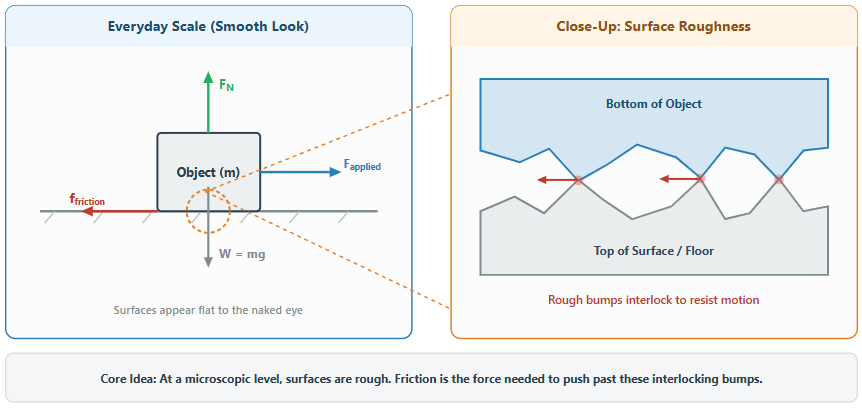
Although solid surfaces may appear smooth to the touch, they have microscopic roughness. When two surfaces are placed against each other, the microscopic bumps and ridges of one surface interlock with the bumps and ridges of the other. Friction is the force needed to overcome this physical interlocking and allow the surfaces to slide past one another.
Direction of Frictional Forces
The frictional force always acts parallel to the contact surface and points in the direction opposite to the relative motion (or impending relative motion) of the object.
Types of Friction
Mechanical contact friction between dry solid surfaces is classified into two distinct physical regimes:
- Static Friction: The tangential resisting force that prevents relative sliding between two surfaces that are stationary relative to each other.
- Kinetic Friction: The tangential resisting force that opposes the relative sliding motion between two surfaces already in relative motion.
Static Friction
Static friction acts when an external force attempts to slide an object along a surface, but relative motion has not yet begun.
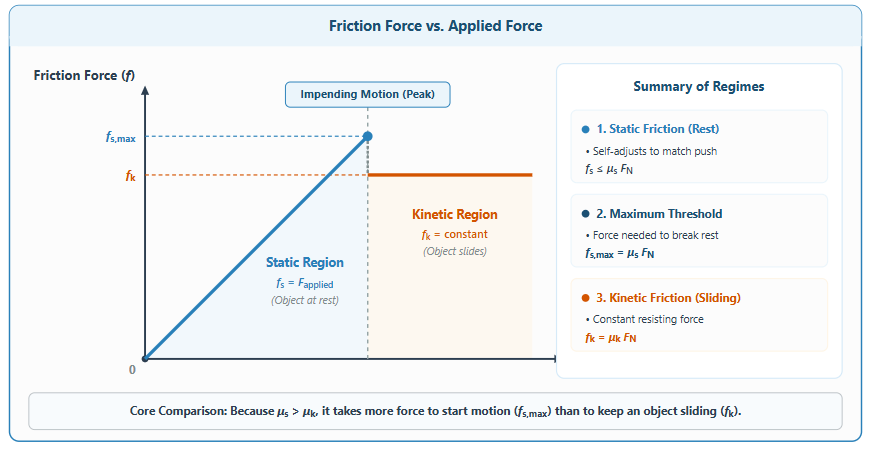
Static friction is a self-adjusting reaction force. If no horizontal force is applied to a resting object on a level surface, the static friction force is zero:
When an applied force attempts to move the object, static friction immediately adjusts its magnitude to exactly balance the applied force, keeping the object in translational equilibrium:
As the applied pushing force increases, static friction increases proportionally until it reaches a well-defined upper limit called the maximum static friction or threshold of impending motion:
Where:
- is the magnitude of the static friction force, measured in newtons
- is the maximum possible static friction force, measured in newtons
- is the dimensionless coefficient of static friction
- is the magnitude of the perpendicular normal force pressing the surfaces together, measured in
The general inequality governing static friction is:
If the applied force is less than or equal to , the object remains at rest and
.
If the applied force exceeds , the microscopic bonds break, the object accelerates, and the interaction transitions into kinetic friction.
Kinetic Friction
Once relative sliding motion begins between two surfaces, static friction vanishes and kinetic friction opposes the continuing motion.
Unlike static friction, kinetic friction does not self-adjust. Its magnitude remains essentially constant over a wide range of sliding speeds and is determined directly by the normal force:
Where:
- is the magnitude of the kinetic friction force, measured in newtons
- is the dimensionless coefficient of kinetic friction
- is the magnitude of the normal force, measured in newtons
Comparison of Friction Coefficients
For nearly all pairs of materials under standard conditions, the coefficient of static friction is greater than the coefficient of kinetic friction:
Consequently, the force required to initiate motion from rest (overcoming ) is greater than the force required to sustain sliding motion at constant velocity (balancing ):
Factors Affecting the Friction Force
Empirical friction laws establish the physical dependencies of dry sliding friction:
- Normal Force Dependence: The friction force is directly proportional to the magnitude of the normal force pressing the two contact surfaces together.
- Independence of Apparent Contact Area: To a strong approximation, the friction force is independent of the apparent macroscopic surface area of contact. While a larger block has more apparent area, the weight is distributed over that larger area, keeping the actual microscopic contact area and total normal load unchanged.
- Independence of Relative Velocity: Within moderate speed ranges, kinetic friction is independent of the relative sliding speed between the two surfaces.
- Surface Composition: The friction coefficients and depend strictly on the nature of the two materials in contact and the cleanliness or roughness of their surfaces.
Example 1: Determining Static and Kinetic Regimes
A wooden crate of mass rests on a level horizontal floor. The coefficient of static friction between the crate and the floor is , and the coefficient of kinetic friction is . Use .
Calculate the magnitude of the friction force acting on the crate when a horizontal pushing force of magnitude is applied, for two cases:
- Case A:
- Case B:
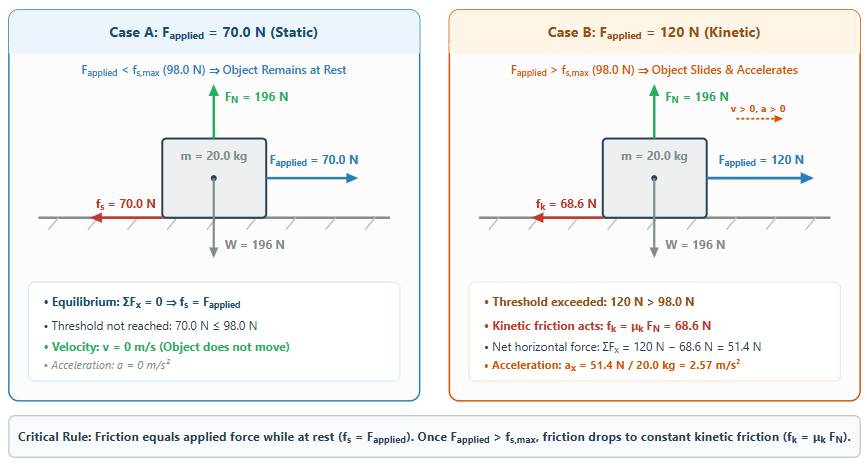
Normal Force Calculation:
On a level horizontal surface with no vertical applied forces, vertical equilibrium applies:
Maximum Static Friction Threshold:
Case A Analysis :
Because , the applied force is insufficient to overcome static friction.
The crate remains stationary in translational equilibrium:
Case B Analysis :
Because , the static threshold is exceeded and the crate slides.
Kinetic friction now opposes the motion:
Example 2: Acceleration with Kinetic Friction
A horizontal pulling force of is applied to a metal box sliding across a concrete floor with a coefficient of kinetic friction . Calculate the magnitude of the horizontal acceleration of the box.
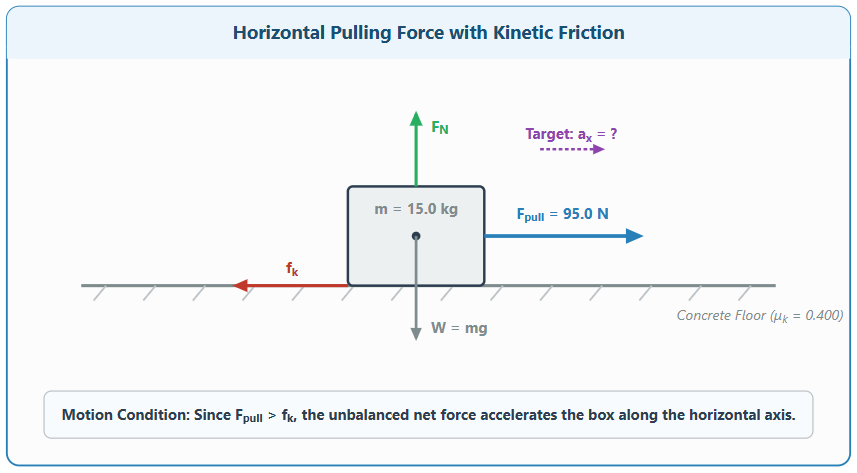
Normal Force:
Kinetic Friction Force:
Horizontal Acceleration:
Applying Newton’s second law along the horizontal axis of motion:
Key Points
- Friction is a contact force that acts parallel to the contact interface and opposes relative motion or the tendency toward relative motion.
- Static friction self-adjusts to match the applied horizontal force up to a maximum limit given by .
- Kinetic friction acts between sliding surfaces with a constant magnitude given by .
- For nearly all surface pairs, , meaning more force is required to initiate motion than to maintain it.
- Friction is proportional to the normal force and, to a first approximation, independent of apparent contact area and sliding speed.