
Definition
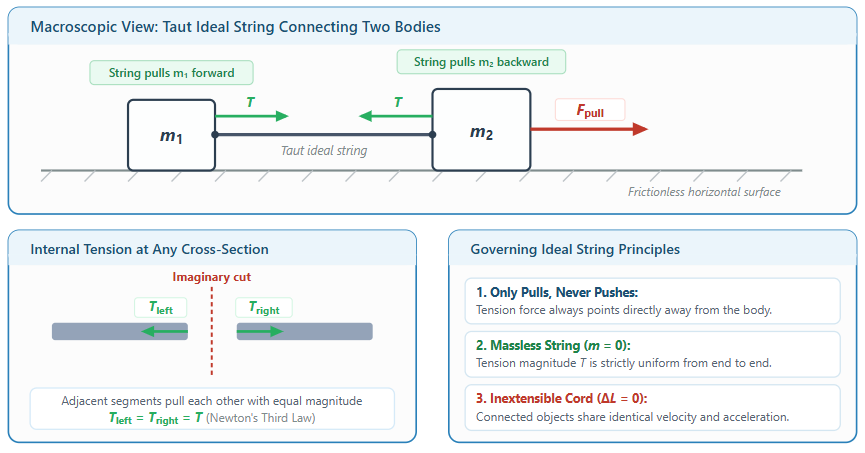
Tension is the pulling contact force transmitted axially through a flexible medium, such as a string, rope, cable, chain, or cord, when it is pulled tight by forces acting from opposite ends. At the macroscopic level, a string under tension acts as a mechanical link that pulls on the objects connected to its ends. At the microscopic level, applying an outward pulling force pulls adjacent atoms slightly further apart than their equilibrium positions. The attractive interatomic electrostatic forces act as tiny microscopic springs that resist this stretching, thereby transmitting the pulling force continuously along the entire length of the medium.
SI Unit
The SI unit of tension is the . Because tension is a mechanical force, it has standard force dimensions:
Properties of Tension and Ideal Strings
In classical dynamics, ropes and strings are typically modeled as ideal elements unless stated otherwise:
- Pulling Direction: A flexible medium can only pull; it cannot push or support compressive loads. The tension force exerted by a string on a connected body always points directly away from the body, along the direction of the string at the attachment point.
- Massless Approximation : An ideal string has negligible mass. Applying Newton’s second law to any segment of a massless string shows that the magnitude of tension is identical at every point throughout the string, even if the entire system is accelerating.
- Inextensible Nature: An ideal string does not stretch . As a consequence, connected bodies linked by a taut inextensible string share the exact same magnitude of velocity and acceleration along the line of the string.
- Ideal Pulleys: An ideal pulley is frictionless and massless. When a taut string passes over an ideal pulley, it changes the direction of the tension force without altering its magnitude.
- Action-Reaction Relationship: According to Newton’s third law, the pulling force exerted by the string on an attached object is equal in magnitude and opposite in direction to the force exerted by that object on the string.
Mathematical Determination of Tension in Common Configurations
Because tension is an adjusting constraint force, it has no standalone universal formula. Its magnitude is determined dynamically by setting up Newton’s second law for the object attached to the cord.
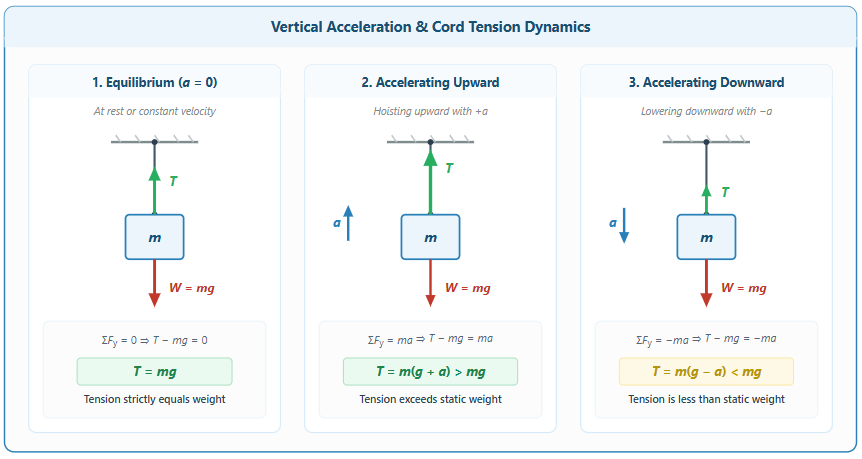
1. Stationary Suspended Mass (Static Equilibrium)
Consider an object of mass m suspended motionless from a ceiling by a single vertical string. Defining the upward vertical direction as positive (+y):
Where:
- is the magnitude of the tension force in the string, measured in newtons
- is the downward gravitational force (weight) of the object, measured in newtons
- is the mass of the suspended object, measured in kilograms
- is the acceleration due to gravity
2. Vertically Accelerating Mass
When an object suspended by a cord accelerates vertically, such as an elevator or a hoisted load, the tension deviates from the static weight:
Case A: Accelerating upward with acceleration a:
The tension exceeds the static weight because the cord must both counter gravity and supply the upward accelerating force.
Case B: Accelerating downward with acceleration a (where a < g):
The tension is less than the static weight . If the cord is cut or snaps, the object falls freely , causing the tension to drop instantly to zero .
3. Horizontal Pulling on a Frictionless Surface
When a horizontal cord pulls a block of mass m along a level frictionless surface with an external applied horizontal acceleration :
Where:
- is the horizontal tension pulling the block forward, measured in newtons
- is the mass of the block, measured in kilograms
- is the resulting horizontal acceleration, measured in meters per second squared Along the vertical axis, the upward normal force balances the downward weight , leaving the horizontal tension as the sole net force accelerating the body.
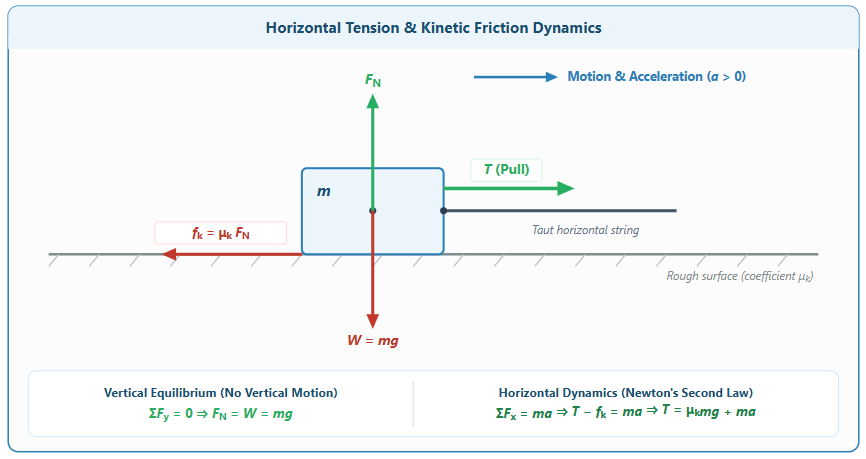
4. Horizontal Pulling with Friction
If the horizontal surface exhibits kinetic friction characterized by coefficient , the net force along the direction of motion is the difference between tension and the opposing friction force:
Where:
- is the kinetic friction force, given by
- is the coefficient of kinetic friction between the object and the surface If the object is pulled at a steady, constant velocity , the tension exactly equals the opposing kinetic friction .
Example 1: Crane Lifting a Construction Crate
A crane cable hoists a heavy storage crate of mass vertically upward from the ground. Assume .
(a) Determine the tension in the cable when the crate is lifted vertically upward with a constant acceleration of .
(b) Determine the tension in the cable once the crate reaches its cruising speed and rises vertically at a constant velocity of .
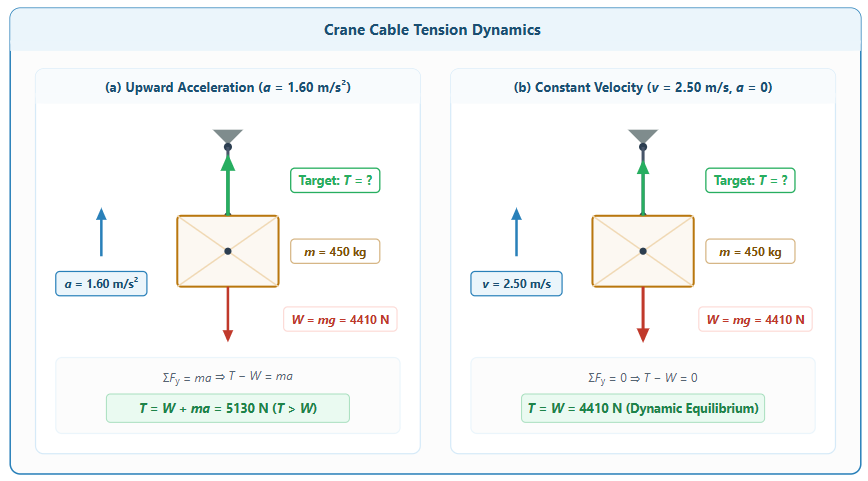
Weight of the Crate:
(a) Upward Acceleration : Define the upward vertical direction as positive (+y).
Applying Newton’s second law along the vertical axis:
The cable tension during upward acceleration is (or ) directed vertically upward.
(b) Upward Constant Velocity :
Because velocity is constant, the acceleration is strictly zero . The crate is in translational dynamic equilibrium:
The cable tension at constant velocity equals the gravitational weight of (or ).
Example 2: Sled Pulled Horizontally Across Snow
A child pulls a loaded sled of total mass across a flat, horizontal patch of snow using a light horizontal tow rope. The coefficient of kinetic friction between the sled runners and the snow is . Assume . If the tension in the rope is maintained at a constant value of , find the resulting horizontal acceleration of the sled.
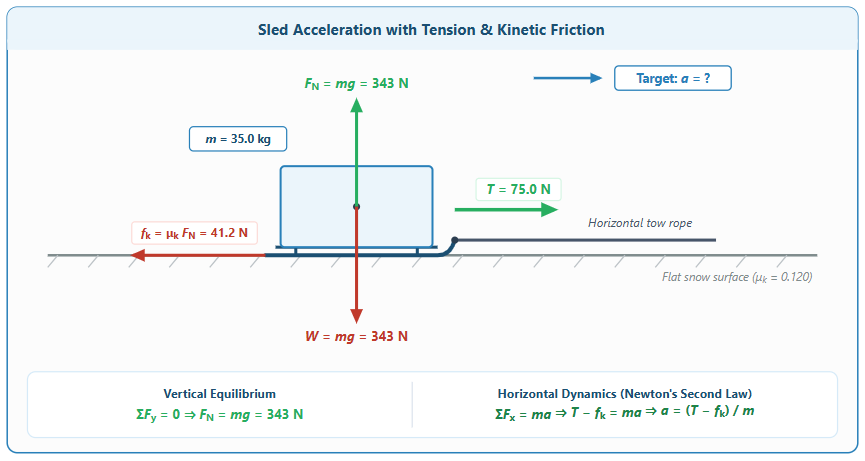
Vertical Equilibrium and Normal Force: Because there is no vertical movement ), the vertical forces balance:
Kinetic Friction Force: The constant kinetic friction opposing the forward pull is:
Horizontal Dynamics and Acceleration: Define the forward direction of motion as positive (+x).
Applying Newton’s second law along the horizontal axis:
The sled accelerates horizontally forward at .
Key Points
- Tension is an axial pulling contact force transmitted through a flexible medium such as a string, cord, or cable.
- A flexible medium can only pull; the tension force always points away from the connected object along the path of the medium.
- An ideal string is massless and inextensible, ensuring uniform tension throughout its length and equal acceleration for connected bodies.
- An ideal frictionless pulley redirects the orientation of the tension force without changing its magnitude.
- Tension is a self-adjusting constraint force determined dynamically via Newton’s second law .
- For a suspended mass accelerating upward, tension exceeds weight ; for downward acceleration, tension is less than weight .
- When moving at constant velocity or remaining at rest, vertical tension on a suspended body strictly balances weight .