
Definition
The spring force is the restoring contact force exerted by a compressed or stretched elastic spring upon any object attached to it. It acts to restore the spring back to its undeformed equilibrium length. At the microscopic level, solid materials maintain an equilibrium spacing between adjacent atoms governed by electrostatic interactions. When an external force stretches a spring, the atoms are pulled farther apart, producing attractive electrostatic forces that pull them back. When the spring is compressed, electron clouds overlap more closely, producing repulsive electrostatic forces. The macroscopic spring force represents the net cumulative result of these microscopic interatomic restoring forces.
SI Unit
The SI unit of force is the . The SI unit of the spring constant k is the newton per meter .
Hooke’s Law
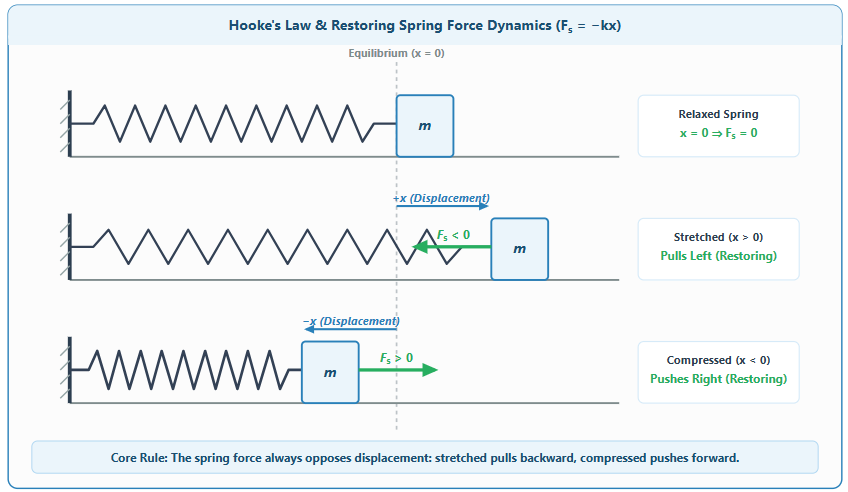
For ideal springs deformed within their elastic limit, the restoring force is directly proportional to the displacement of the spring’s end from its relaxed equilibrium position. This relationship is governed by Hooke’s law:
Where:
- is the restoring force exerted by the spring, measured in newtons
- is the spring constant (stiffness) of the spring, measured in newtons per meter
- is the displacement of the end of the spring from its undeformed equilibrium position , measured in meters The negative sign indicates that the spring force is a restoring force; its direction is always opposite to the direction of the displacement from equilibrium:
- When the spring is stretched , the spring force pulls back in the negative direction .
- When the spring is compressed , the spring force pushes outward in the positive direction .
- At the undeformed equilibrium position , the spring force is zero .
The Spring Constant and Elastic Limit
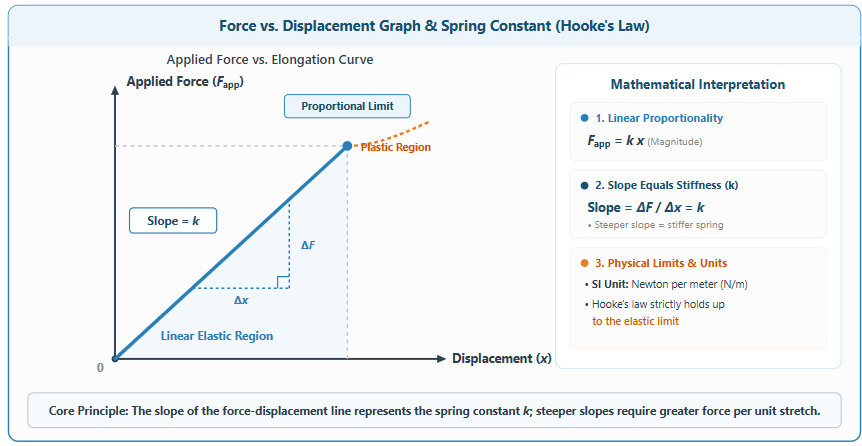
The spring constant k represents the stiffness or rigidity of the spring. A stiff spring requires a large force to produce a small deformation and possesses a high value. A loose or soft spring deforms readily under small forces and has a low value. Hooke’s law applies strictly within the elastic limit of the material:
- Proportional Limit: The maximum stress or deformation beyond which the linear proportionality between force and displacement breaks down.
- Elastic Limit: The maximum deformation an object can undergo and still return completely to its original undeformed shape upon removal of the load. Exceeding this limit causes permanent plastic deformation.
Force versus Displacement Graph
When plotting the magnitude of the applied stretching force against displacement , the relationship produces a straight line passing through the origin:
The slope of this force-displacement graph directly represents the spring constant k:
Equilibrium in Spring Systems
Because the spring force varies with position, analyzing spring systems requires applying Newton’s second law at static equilibrium or along an accelerated axis.
1. Vertical Suspended Mass-Spring System
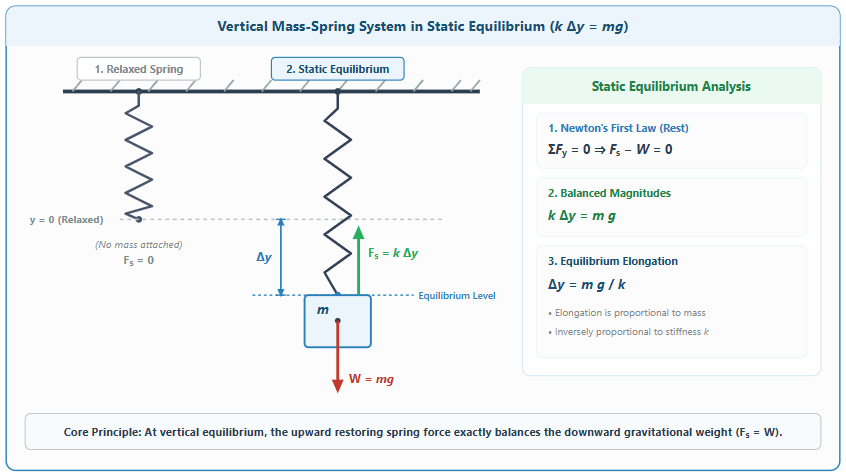
Consider a spring of stiffness hanging vertically from a rigid support. When a block of mass m is attached to its lower end, the spring stretches downward by a distance until reaching a new static equilibrium position. Defining the upward direction as positive (+y):
Where:
- is the vertical elongation of the spring at equilibrium, measured in meters
- is the mass of the suspended object, measured in kilograms
- is the acceleration due to gravity
- is the downward gravitational weight of the object, measured in newtons
2. Horizontal Mass-Spring System with Friction
Consider a block of mass m attached to a horizontal spring on a surface with kinetic friction coefficient . If the spring is stretched by a distance and released, the net force governing the horizontal acceleration as the block moves back toward equilibrium is:
Where:
- is the opposing kinetic friction force, given by
- is the supporting normal force, measured in newtons
Combinations of Springs
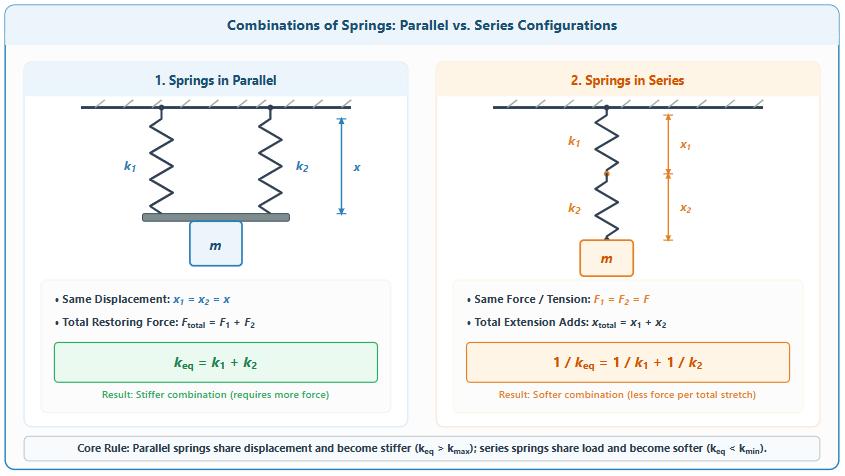
When multiple springs are connected together, they can be modeled as a single equivalent spring with effective spring constant .
1. Springs in Parallel
When two springs with constants and are mounted side-by-side in parallel, they undergo the identical displacement when loaded. The total restoring force is the sum of the individual forces:
2. Springs in Series
When two springs are connected end-to-end in series, both springs experience the exact same tension force , but their individual extensions and add together:
Example 1: Vertical Extension Under Load
A lightweight spring hangs vertically from a ceiling. When a mass of is suspended from its lower end, the spring stretches by to reach a steady equilibrium position. Assume .
(a) Calculate the spring constant of the spring.
(b) Determine the additional elongation produced if an additional mass is added to the system.
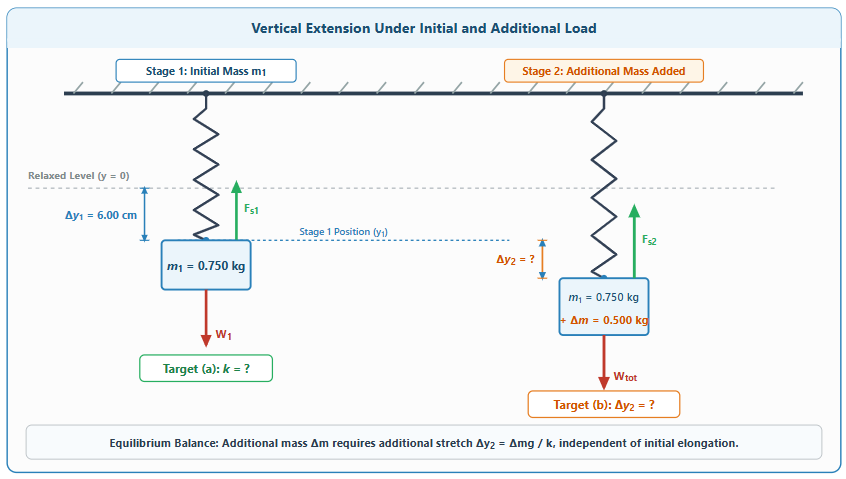
Equilibrium Condition: Convert the elongation into meters:
The downward weight is balanced by the upward spring force:
(a) Determining the Spring Constant k:
The spring constant is .
(b) Additional Elongation:
The additional stretching depends solely on the additional mass
The additional elongation of the spring is .
Example 2: Horizontal Spring Acceleration
A block of mass rests on a frictionless horizontal tabletop and is connected to a horizontal spring with spring constant . The block is pulled horizontally, stretching the spring by from its equilibrium position, and then released from rest. Calculate the initial acceleration of the block at the instant of release.
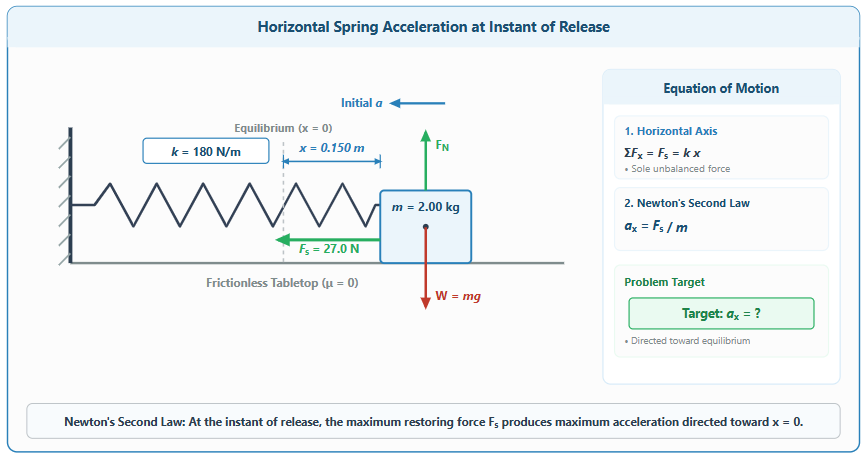
Horizontal Force Resolution: Define the direction toward the equilibrium position as positive. Because the tabletop is frictionless, the spring force is the sole unbalanced horizontal force acting on the block:
Determining Initial Acceleration: Applying Newton’s second law along the horizontal axis:
The initial acceleration of the block at the instant of release is directed toward the equilibrium position.
Key Points
- The spring force is a restoring force directed toward the undeformed equilibrium position.
- Hooke’s law states that restoring force is directly proportional to displacement within the elastic limit:
- The spring constant measures the stiffness of the spring; its SI unit is the newton per meter .
- On a force versus displacement graph, the slope represents the spring constant k.
- For a vertically hanging mass in static equilibrium, the spring force equals the downward gravitational weight: .
- For springs in parallel, equivalent stiffness adds directly: .
- For springs in series, reciprocals add: .
4.9 Free-Body Diagrams →